
How ATS Systems Actually Filter Your Resume (From Someone Who Configured Them)
You just submitted your resume for that hot Senior AI Engineer role, and crickets. No email, no call, just... silence. This isn't a coincidence. Before a human even glances at your application, your resume has to survive the Applicant Tracking System (ATS), the digital gatekeeper for most companies.
You just submitted your resume for that hot Senior AI Engineer role, and crickets. No email, no call, just... silence. This isn't a coincidence. Before a human even glances at your application, your resume has to survive the Applicant Tracking System (ATS), the digital gatekeeper for most companies. In 2026, over 97% of companies rely on these systems ATS Optimization (2026): 7 Proven Techniques to Pass ATS, and if your resume isn't ATS-friendly, you're effectively invisible. Many job seekers are blindsided by how ATS systems filter resumes, leading to frustration when qualified candidates never reach a recruiter. While some claim up to 75% of resumes are rejected before a human sees them Why 75% of Resumes Get Rejected Before a Human Sees Them, the reality is more nuanced: poorly formatted or keyword-mismatched documents get deprioritized or poorly parsed, drastically reducing their chances. It's not always an outright rejection, but a silent demotion. Understanding the underlying mechanics of resume parsing ATS is crucial to avoiding this digital black hole.
These systems are designed to handle the sheer volume of applications many companies receive; as stated, they help filter, sort, and prioritize candidates Why 75% of Resumes Get Rejected Before a Human Sees Them. The core function of an ATS is to parse your resume, breaking down the information into standardized fields. This parsing process involves extracting key data points like contact information, work experience, education, and skills. However, the effectiveness of this extraction hinges heavily on how your resume is structured. For instance, using columns or tables can confuse the system, causing it to read text out of order or miss crucial information entirely How to write a resume that works with Al screening tools in 2026. Similarly, information placed in headers and footers often struggles to be read by many systems How to write a resume that works with Al screening tools in 2026. It's important to note that the system isn't necessarily saying "no" to you outright based on content; rather, it's a matter of whether it can accurately read and interpret the information you've provided I spent 8 months testing how ATS systems actually parse resumes. The ATS then scores your resume based on how well it matches the job description, a process often referred to as ATS optimization How To Make Your Resume ATS-Friendly - Staffing by Starboard, ATS Optimization (2026): 7 Proven Techniques to Pass ATS. This scoring determines whether your resume progresses to the next stage, often involving a human recruiter.
The Real Answer
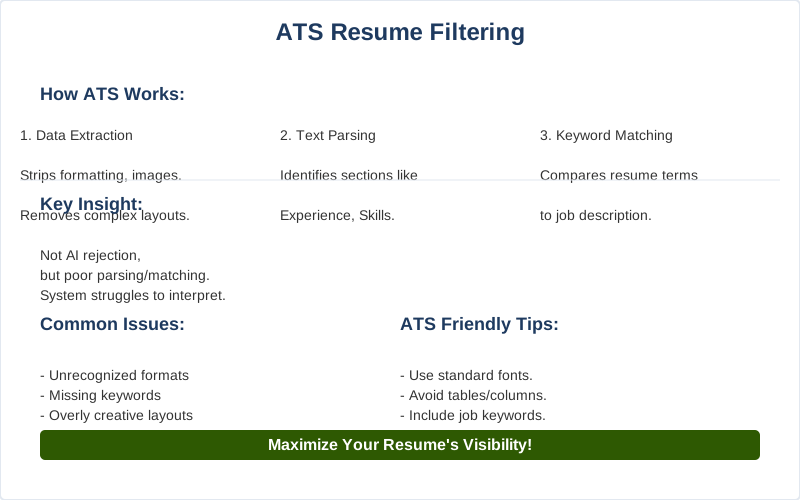
Your resume isn't being "rejected" by an AI; it's being poorly parsed or inadequately matched by software designed for high-volume filtering. The system isn't making a judgment on your qualifications; it's struggling to interpret your data.
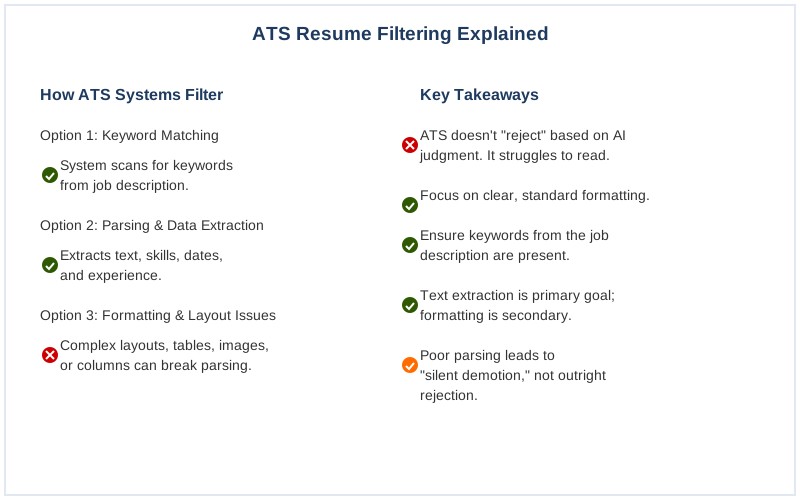
Forget the myth of AI auto-rejection based on a hidden score. A survey of 630 recruiters found 92% say their ATS does NOT auto-reject based on content I spent 8 months testing how ATS systems actually parse resumes. The real issue is how the system parses and matches information. When you upload your resume, the ATS extracts text, stripping away formatting, images, and complex layouts. If your resume uses columns or tables, the text can get jumbled, making it unreadable to the system davron.net.
The primary function of an ATS is to filter and sort candidates when hiring teams receive hundreds, or even thousands, of applications. It's a triage system, not a sophisticated evaluator. While some systems use machine learning to rank candidates, like Workday, they don't auto-delete applications based on a simple score Debunking ATS Myths: Greenhouse, Workday, Lever - LinkedIn. The goal is to quickly identify relevant profiles for human review.
The common statistic that 75% of resumes are rejected by ATS before a human sees them is likely an oversimplification or misinterpretation of how filtering works davron.net. What's true is that poorly formatted or keyword-mismatched resumes get deprioritized or poorly parsed, drastically reducing their chances of being reviewed by a person. Over 70% of resumes can be filtered out by Applicant Tracking Systems (ATS), never even reaching a recruiter How To Make Your Resume ATS-Friendly - Staffing by Starboard.
ATS systems scan for specific keywords and phrases that directly match the job description. If critical terms are missing, the resume may be overlooked. Modern ATS also employ semantic matching, meaning they understand context, not just exact word matches davron.net. This is why ATS keyword matching is so critical; it's the core mechanism for initial screening.
What's Actually Going On
How to Handle This
What This Looks Like in Practice
- Senior Software Engineer at a Series B Startup. This engineer used a resume packed with a custom two-column layout and embedded graphics. The ATS parsing failed, rendering much of the technical skills and project experience unreadable to the system. While the candidate had strong experience, the resume's design prevented it from being properly scored, meaning it likely never reached a human reviewer ATS Optimization (2026): 7 Proven Techniques to Pass ATS.
- Entry-Level Data Analyst at a Large Tech Company. This applicant submitted a clean, text-based resume with a strong emphasis on relevant keywords from the job description. The resume was easily parsed, and the system correctly identified key skills like SQL, Python, and data visualization tools. This ATS keyword matching allowed the resume to be prioritized, leading to an interview, even with limited professional experience Why 75% of Resumes Get Rejected Before a Human Sees Them.
- Career Changer from Teaching to Product Management. This candidate's resume initially struggled because it heavily featured teaching-specific jargon and lacked common product management terms. The ATS flagged it as a poor match. After revising to highlight transferable skills like project leadership, stakeholder communication, and strategic planning using PM terminology, the resume performed significantly better. This demonstrates how resume parsing ATS systems weigh specific language ATS Optimization (2026): 7 Proven Techniques to Pass ATS.
- Mid-Level Marketing Manager at a CPG Company. A resume submitted with a common template that included headers and footers for contact information and page numbering caused issues. Some ATS systems struggle to accurately read information placed in headers and footers, leading to incomplete data extraction. This candidate's resume was deprioritized because the system couldn't reliably capture all their stated achievements ATS Optimization (2026): 7 Proven Techniques to Pass ATS.
Mistakes That Kill Your Chances
Here are common mistakes that kill your chances with ATS systems:
Key Takeaways
- The ATS isn't your enemy, it's a tool that manages application volume. While claims of 75% of resumes being rejected before human review persist Why 75% of Resumes Get Rejected Before a Human Sees Them, a recent survey found 92% of recruiters state their ATS does NOT auto-reject based on content I spent 8 months testing how ATS systems actually parse resumes. It's about prioritization and parsing failures, not outright rejection.
- Your resume is parsed to extract raw text, stripping formatting, images, and complex layouts. Columns or tables can jumble text, making it unreadable How to write a resume that works with Al screening tools in 2026. This garbled text is then scanned for keywords and semantic matches against the job description.
- The "keyword gap" is real and a primary reason qualified candidates are overlooked. Over 70% of resumes are filtered out for lacking specific employer search terms How To Make Your Resume ATS-Friendly - Staffing by Starboard. With over 97% of companies using ATS in 2026, optimization is crucial for visibility ATS Optimization (2026): 7 Proven Techniques to Pass ATS.
- Focus on clarity and keywords. Fancy designs are irrelevant if the ATS can't read it. The system ranks your resume on how well it extracts and matches relevant information.
Frequently Asked Questions
How does an ATS actually read my resume?
So, the ATS is looking for specific keywords, right? How does that work?
Does the ATS automatically reject my resume if it doesn't have enough keywords?
Are there specific ATS systems that are known for being trickier to get through?
What kind of formatting issues trip up ATS systems the most?
I've heard the '75% of resumes get rejected' stat a lot. Is that true?
Sources
- resumeadapter.com
- davron.net
- Why 75% of Resumes Get Rejected Before a Human Sees Them
- Debunking ATS Myths: Greenhouse, Workday, Lever - LinkedIn
- How to write a resume that works with Al screening tools in 2026
- ATS Optimization (2026): 7 Proven Techniques to Pass ATS
- assurant.com
- I spent 8 months testing how ATS systems actually parse resumes
- How To Make Your Resume ATS-Friendly - Staffing by Starboard
- How does Greenhouse use AI? Here's everything candidates need ...