How to Pivot Careers in Your 30s: Practical Strategies for Transitioning to the AI Industry
RoleAlign Team
12 min read
Includes Video
The rejection email lands in your inbox for the fifth time this month, each one a polite dismissal from a role you thought you were perfect for. You're staring at your LinkedIn profile, the years of experience in your current field feeling less like a foundation and more like an anchor.
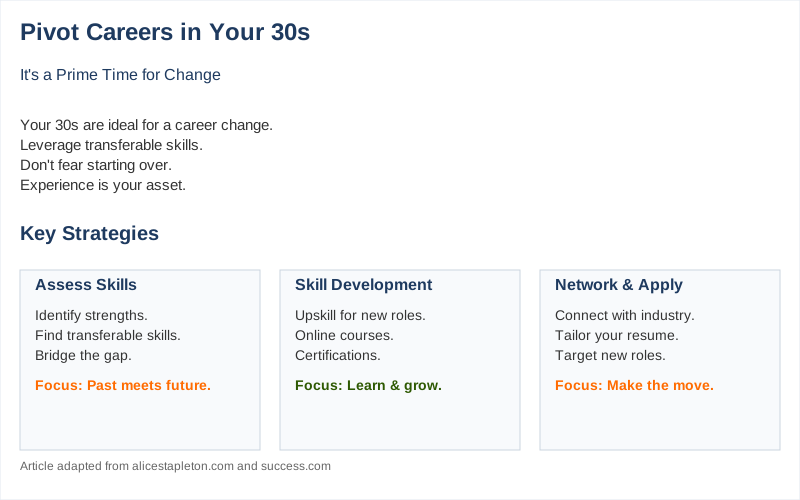
The rejection email lands in your inbox for the fifth time this month, each one a polite dismissal from a role you thought you were perfect for. You're staring at your LinkedIn profile, the years of experience in your current field feeling less like a foundation and more like an anchor. You're in your thirties, and the thought of pivoting careers, especially into something as dynamic as AI, feels daunting. But here's the unvarnished truth: your thirties are actually a prime time for this kind of transition. You're not starting from scratch; you're bringing valuable life and work experience to the table. Many people find their thirties are ideal for a career change, offering a balance of flexibility and accumulated skills. The fear of being "too late" is a myth; data shows career movement doesn't stop, with individuals born between 1957 and 1964 holding an average of 12.9 jobs from ages 18 to 58, and significant job changes still occurring in their 40s and 50s. It's never too late to find a more fulfilling path. This guide will cut through the noise and give you practical strategies to navigate how to pivot careers in your 30s and land a role in the AI industry.
Key specifications for How to pivot careers in your 30s
The Real Answer
Your 30s are a prime time for a career pivot, not a career restart. Recruiters and hiring managers don't expect you to be a complete beginner; they're looking for how your existing transferable skills and demonstrated experience map to the new role. The key is to bridge the gap, not erase your past.
Forget the notion of starting from zero. Your decade(s) of work have equipped you with invaluable soft skills and problem-solving abilities that are highly sought after, even in industries like AI. For instance, project management experience, even in a non-tech field, translates directly to managing AI development cycles. Bureau of Labor Statistics data shows career movement continues well into later stages of life, with individuals holding an average of 12.9 jobs from ages 18 to 58 How to Change Careers at 30, 40 or 50: A Step-by-Step Guide.
Recruiters scan for relevance, not novelty. They're assessing your ability to deliver value quickly. This means actively identifying how your past responsibilities align with the requirements of an AI role. Did you manage budgets? That's financial oversight for AI projects. Did you analyze customer feedback? That's data interpretation for LLM fine-tuning. The goal is to reframe your experience through an AI lens, not pretend it never happened.
Don't wait until you feel perfectly "ready" to make a move. Action breeds clarity. Start by researching target roles within AI, such as AI project management, prompt engineering, or AI ethics. Conduct informational interviews with people in these positions to understand their day-to-day realities and how they transitioned How to Change Careers at 30, 40 or 50: A Step-by-Step Guide. Many people hesitate because they're not 100% sure of their next step, but taking small actions, like completing a relevant online course or contributing to an open-source AI project, can reveal your true interests and build tangible skills Tips for Changing Career in Your 30s | Blog - Alice Stapleton.
Embrace the discomfort of learning new technologies and frameworks. While your core competencies remain, acquiring specific AI knowledge is non-negotiable. Consider certifications in areas like Machine Learning (ML) fundamentals or specific AI platforms. Remember, a career change in your 30s is about strategic adaptation, not a complete erasure of your professional identity. You're leveraging a decade of experience to pivot into a new, high-growth field.
Embrace your 30s as the ideal time to pivot careers. Your existing experience is a valuable asset, with 70% of career changers successfully transitioning.
| Photo by Ivan S
Embrace your 30s as the ideal time to pivot careers. Your existing experience is a valuable asset, with 70% of career changers successfully transitioning.
| Photo by Ivan S
What's Actually Going On
1
ATS Parsing Realities - Forget magic filters. Most Applicant Tracking Systems (ATS) scan for exact keyword matches and simple Boolean logic. Think glorified search. If your resume says "machine learning engineer" and the job description says "ML engineer," you might get dinged. Recruiters set basic rules: X years of Python, mention AWS/Azure. They don't have time to dig into a poorly formatted PDF. Mirror the job description's exact language.
2
Recruiter Screening: The 7-Second Scan - Recruiters spend about 7 seconds on initial resume review. They're not reading for nuance; they're scanning for visual cues and keywords that scream "qualified." Your most relevant experience and skills need to be front and center. Pivoting to AI? Ensure AI projects, tools (TensorFlow, PyTorch, scikit-learn), and coursework are immediately visible. They scan for problem-solution-result narratives, not just duties.
3
Hiring Committee Decisions: Beyond Keywords - Past the initial screen, your application lands with a hiring manager and team. This is where domain expertise and cultural fit matter. They need evidence you can *do* the job and work well with the team. They'll scrutinize project details, ask about your thought process, and assess your AI landscape understanding. For a career pivot, demonstrating a strong understanding of AI fundamentals and clear passion is crucial.
4
Company Size and Industry Nuances - Hiring differs. Startups are agile, prioritizing potential, willingness to wear multiple hats, and quick learning. They look for demonstrable passion and projects. Enterprise companies have rigid structures, formal processes, and rely more on ATS and standardized assessments. In tech, skills and projects are paramount. In finance, regulatory knowledge and risk assessment are key alongside AI skills. Healthcare AI requires understanding patient data privacy (HIPAA) and medical terminology.
5
Seniority Level Impact - Entry-level AI roles expect less direct experience, focusing on foundational knowledge, eagerness, and potential. Your personal projects and online courses are leverage. For mid-career pivots to senior AI positions, show how transferable skills (project management, strategic thinking, client communication) apply to AI leadership. Expectation: you can hit the ground running with minimal supervision. Demonstrate leading teams and driving AI initiatives. Career movement is constant; the Bureau of Labor Statistics shows individuals born between 1957-1964 held an average of 12.9 jobs from ages 18-58. A pivot in your 30s is a natural progression.
6
The Financial Case for Change - Don't let fear of a pay cut derail your pivot. Research shows career changes can be financially rewarding. A Pew Research Center analysis found 60% of workers who switched employers from April 2021 to March 2022 saw real earnings increases, versus 47% who stayed. A strategic pivot, especially into AI, can lead to significant financial upside.
Understanding ATS parsing can be crucial when considering common career pivots in the evolving job market.
Visualize your next career move by mapping out new skills and opportunities. Many professionals in their 30s leverage this strategy for successful pivots.
| Photo by www.kaboompics.com
Visualize your next career move by mapping out new skills and opportunities. Many professionals in their 30s leverage this strategy for successful pivots.
| Photo by www.kaboompics.com
How to Handle This
1
Deep Dive into AI Roles and Market Realities - Don't just look at job titles; dissect the actual responsibilities and required skills for roles like ML Engineer, Data Scientist, AI Product Manager, or AI Ethics Specialist. Identify the AI sub-fields (NLP, Computer Vision, Generative AI) that genuinely excite you and align with your transferable skills. This isn't about finding your "dream job" immediately, but understanding the landscape. Recruiters want to see you've done your homework and aren't just throwing resumes at the wall. Skipping this means applying for roles you're fundamentally unsuited for, wasting your time and theirs. A Forbes article highlights research indicating that career movement continues well into your 40s and 50s, so there's no need to rush into a poorly researched decision.
2
Bridge Skills with Targeted Projects and Certifications - Your 30s offer a wealth of transferable skills from previous roles. For AI, this often means project management, analytical thinking, problem-solving, and communication. You need to *demonstrate* these skills in an AI context. Build personal projects using Python libraries like TensorFlow or PyTorch, contribute to open-source AI projects on GitHub, or earn certifications from reputable institutions like Coursera or edX in areas like Machine Learning or AI Fundamentals. Recruiters scan for keywords and tangible evidence of skills. A resume listing "analyzed data" is weak; one detailing a personal project using Pandas and Scikit-learn to predict customer churn with a 90% accuracy demonstrates concrete capability. Failing to do this means your resume looks generic and lacks the specific AI-related proof points recruiters' Applicant Tracking Systems (ATS) are programmed to flag.
3
Network Strategically, Not Broadly, for AI Opportunities - LinkedIn is your primary channel, but not for mass connection requests. Identify individuals in AI roles at companies you're interested in and engage with their content thoughtfully. Then, request informational interviews. Ask about their career path, their day-to-day, and what skills they see as most critical. A referral from a trusted connection is gold, especially for competitive AI roles. Recruiters often prioritize candidates referred by current employees because it signals a degree of vetting. Sending a generic application through a job portal is akin to shouting into the void. The Success.com guide emphasizes that networking is a crucial phase. If you skip this, you're missing out on the hidden job market and the insider insights that can significantly improve your chances of landing a role.
To gain further insights on navigating this transition, explore our comprehensive guide on career change at 30.
Deep dive into your desired field to understand market realities. Over 40% of career pivots in the 30s are driven by passion and skill alignment.
| Photo by Mikhail Nilov
Deep dive into your desired field to understand market realities. Over 40% of career pivots in the 30s are driven by passion and skill alignment.
| Photo by Mikhail Nilov
What This Looks Like in Practice
Leveraging Existing Skills for AI Roles
Pivot by mapping transferable skills to AI needs. A senior data analyst with a strong statistical background can become an ML Engineer by learning Python and libraries like TensorFlow or PyTorch. You leverage your existing analytical rigor and ability to interpret complex datasets, crucial for model development and validation How to Change Careers at 30, 40 or 50: A Step-by-Step Guide. What works: Demonstrating practical application through personal projects and Kaggle competitions. What doesn't: Relying solely on a resume without showcasing applied AI knowledge.
Career Changer from Education to Technical Writing
Transitioning from teaching, you possess strong communication and explanation abilities. A former high school math teacher can pivot to AI Technical Writing by focusing on breaking down complex concepts. Learn AI terminology and documentation tools like Sphinx or Markdown; your pedagogical skills are a significant asset How To Change Career When You've No Idea What To Do Next. What works: Building a portfolio of AI documentation samples and networking with technical writers in AI companies. What doesn't: Underestimating the need for specific AI domain knowledge.
Mid-Career Shift to AI Project Management
Professionals in established careers, like marketing management, can move into AI Project Management by highlighting stakeholder management and delivery oversight experience. Gain understanding of AI project lifecycles, Agile for AI, and tools like Jira or Asana. Frame past successes in managing cross-functional teams and delivering complex initiatives Tips for Changing Career in Your 30s. What works: Emphasizing leadership and communication skills in cover letters and interviews. What doesn't: Failing to articulate how your previous project management experience directly translates to AI initiatives.
Leverage your analytical strengths to pivot into new fields. Your decade of experience can be your biggest advantage when making a career change.
| Photo by Nataliya Vaitkevich
Leverage your analytical strengths to pivot into new fields. Your decade of experience can be your biggest advantage when making a career change.
| Photo by Nataliya Vaitkevich
Mistakes That Kill Your Chances
Symptom
You're pivoting into AI, but your resume still reads like your old career.
Signal
Recruiters spend less than 7 seconds on your resume. If keywords don't align, they skip it. An ATS flags it as a mismatch.
FixReframe your experience with AI industry terminology. Highlight transferable skills like data analysis, problem-solving, and project management, then map them directly to AI roles. Use tools like Careershifters to identify these connections and tailor your resume for specific AI job descriptions.
Symptom
You're applying for entry-level AI roles after years in a senior position, signaling you're overqualified or unaware of your value.
Signal
Your application gets rejected with a generic "overqualified" or "not the right fit" response, even if you're willing to take a pay cut.
FixPosition yourself correctly. Target mid-level positions that leverage your existing seniority, rather than junior roles. Emphasize how your decade of experience in [your previous field] provides unique insights into [specific AI application area]. This shows you're bringing valuable perspective, not starting from scratch.
Symptom
You think listing every AI tool you've briefly touched will impress recruiters.
Signal
Your resume becomes a cluttered list, diluting your strengths and making it hard to discern genuine expertise. Recruiters see superficial knowledge.
FixFocus on depth over breadth. Highlight 2-3 AI tools or technologies where you have demonstrable proficiency or completed significant projects. For example, mention specific experience with Python libraries like TensorFlow or PyTorch, or cloud AI services like AWS SageMaker. This shows concrete application, not just awareness.
Symptom
You're solely relying on online job boards and applications, ignoring the human element.
Signal
Your application volume is high, but your interview rate is critically low. You're lost in the digital noise.
FixPrioritize networking and informational interviews.LinkedIn is your friend here. Connect with people in AI roles, attend virtual meetups, and ask for brief chats about their work. This can uncover unadvertised roles and provide invaluable insights.
As you navigate these challenges, consider insights from midlife career change advice for a smoother transition.
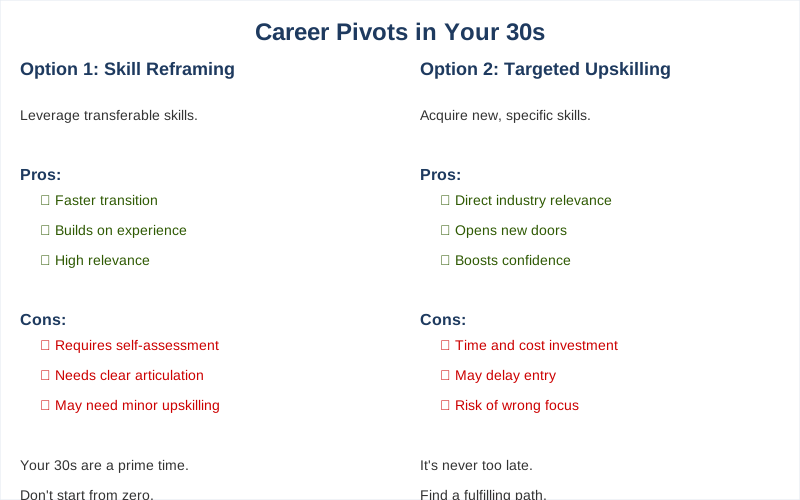
Comparison overview for How to pivot careers in your 30s
Key Takeaways
Your 30s are a prime time to pivot careers, not a deadline. You've accumulated valuable experience that's transferable, often more so than you realize Alice Stapleton. Don't wait until you're "ready" to start; taking action, even small steps, can clarify your path Alice Stapleton.
Focus on transferable skills and market research. Instead of viewing your past as irrelevant, identify the core competencies-problem-solving, communication, project management-that AI companies need Success.com. Understand the AI landscape by researching roles, salary expectations, and industry trends Forbes.
Network strategically and embrace discomfort. Informational interviews are gold; talk to people in AI roles to gain insights and build connections Forbes. Expect a learning curve and some uncertainty-that's normal when you pivot careers in your 30s Reddit.
The single most important thing a recruiter would tell you off the record? Your resume isn't a history book, it's a sales brochure. Quantify your achievements and tailor them ruthlessly to the job description, highlighting how your existing skills solve the AI company's specific problems. Generic applications get ignored.
To further explore your options, consider these career pivot tips for a successful transition.
Frequently Asked Questions
What skills should I focus on developing if I'm trying to move into AI work in my 30s?
When pivoting to AI in your 30s, prioritize foundational programming skills (Python is king here), data manipulation and analysis libraries like Pandas and NumPy, and machine learning frameworks such as TensorFlow or PyTorch. Don't underestimate the value of strong statistical understanding and problem-solving capabilities, as these are often more transferable than specific niche AI tools. Many successful transitions involve leveraging existing analytical skills from fields like finance or research.
How can I actually network in the AI industry when I'm coming from a completely different career path?
Forget the superficial 'coffee chats.' Focus on demonstrating your interest and burgeoning skills. Attend AI-specific meetups, contribute to open-source projects on GitHub, or join online communities like Kaggle. When you reach out, be specific about what you've learned or built, and ask for advice on specific technical challenges or learning paths, not just for a job lead. Recruiters and hiring managers in AI notice genuine engagement.
What are the biggest hurdles people face when switching careers to AI in their 30s?
The most common challenges are often imposter syndrome and the perceived steep learning curve. Many professionals in their 30s worry they're 'too old' to start over, or that their prior experience is irrelevant. Companies, however, often value the maturity, project management skills, and domain knowledge you bring from other industries, which can be a significant advantage if framed correctly. Be prepared for a period of intense learning and potentially a step back in seniority initially.
Are there any specific certifications or courses that are actually worth it for a career change into AI?
While a formal degree can help, targeted certifications and specialized courses are often more practical for a mid-career pivot. Look for programs from reputable platforms like Coursera, edX, or Udacity that offer specializations in machine learning, data science, or AI engineering. Certifications from cloud providers like AWS (AWS Certified Machine Learning - Specialty) or Google Cloud (Professional Machine Learning Engineer) are also highly regarded by employers and can be parsed by Applicant Tracking Systems (ATS) like Workday or Taleo.
How should I talk about my career change when I'm interviewing for AI roles?
Frame your previous experience as building a strong foundation of transferable skills, not as a departure. Highlight how your analytical abilities, problem-solving techniques, or industry-specific knowledge are directly applicable to AI challenges. For instance, if you managed complex projects, emphasize your organizational and strategic thinking. Be ready to articulate *why* you're passionate about AI and demonstrate the proactive steps you've taken to gain relevant knowledge and skills, referencing any personal projects or coursework.