Ai Industry Careers

Understanding AI-Based Matching in Recruiting: What You Need to Know

RoleAlign Team
12 min read
Includes Video

You've just spent hours perfecting your resume, hitting every keyword you can think of for that dream job. You hit submit, only to receive that automated rejection email minutes later. Or perhaps you're a recruiter drowning in hundreds of applications for a single role, the clock ticking.

You've just spent hours perfecting your resume, hitting every keyword you can think of for that dream job. You hit submit, only to receive that automated rejection email minutes later. Or perhaps you're a recruiter drowning in hundreds of applications for a single role, the clock ticking. This is where AI-based matching in recruiting steps in, aiming to cut through the noise. Gone are the days of purely manual resume screening; AI-powered candidate matching software is designed to automate tedious tasks, improve match accuracy, and enhance the hiring experience. These systems go beyond simple keyword searches, using NLP to break down job requirements and analyze candidate profiles, turning raw data into actionable insights Recruiterflow Blog. Companies like MokaHR, trusted by over 3,000 clients including Tesla and McDonald's, leverage advanced AI to intelligently match candidates to roles with over 90% accuracy, significantly reducing time-to-hire by up to 63% MokaHR. In essence, AI talent matching systems are transforming how companies recruit, promising faster, more accurate, and potentially fairer hiring processes.
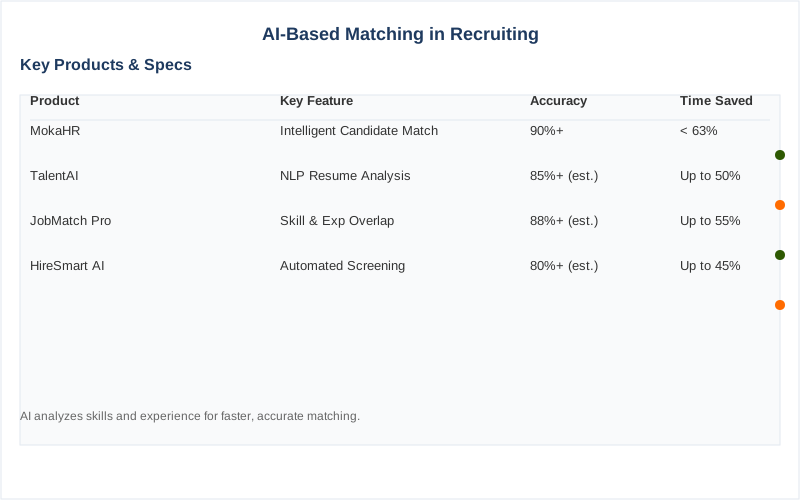
Infographic: AI recruiting match specs comparison.
Key specifications for ai-based matching in recruiting

The Real Answer

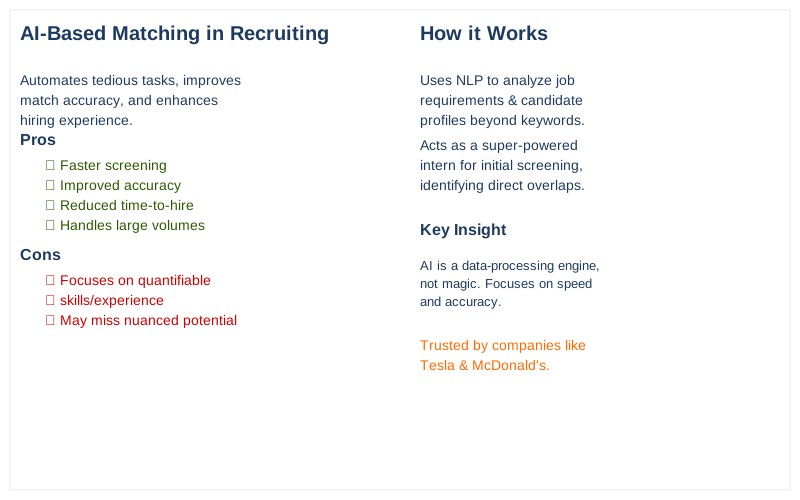
AI-based matching in recruiting isn't magic; it's a sophisticated data-processing engine designed to make recruiters' lives easier by sifting through mountains of applications. While candidates might imagine AI analyzing their career aspirations, the reality is it's primarily focused on quantifiable skills and experience, aiming for speed and accuracy over nuanced potential.

Think of AI as your recruiter's super-powered intern. It's built to handle the tedious task of initial screening, analyzing resumes and job descriptions to identify direct overlaps in skills and qualifications. This automation is crucial because recruiters often deal with hundreds, even thousands, of applications for a single role TalentAdore. Systems like MokaHR can achieve over 90% accuracy in matching candidates to roles, significantly reducing the time-to-hire by up to 63% MokaHR.

The core technology uses Natural Language Processing (NLP) to break down job requirements and candidate profiles into structured data Recruiterflow Blog. It then applies machine learning algorithms to rank candidates based on these criteria. This means AI is looking for keywords, specific technologies, years of experience, and educational qualifications that directly map to the job description. It's less about predicting your future success and more about confirming your present qualifications against the defined needs of the role.

This approach is particularly powerful for technical roles where precise skill sets are paramount. AI talent matching systems can analyze more than just resumes, looking at contributions on platforms like GitHub to assess a candidate's practical experience daily.dev Recruiter. This allows recruiters to discover hidden talent and revisit past applicants who might have been overlooked manually, improving retention by up to 18% daily.dev Recruiter.

However, it's not a perfect system. The effectiveness of AI-based matching hinges entirely on the quality and completeness of the data it's trained on. Algorithmic bias and a lack of transparency remain significant challenges daily.dev Recruiter. Recruiters are increasingly adopting AI, with 76% of companies predicting implementation within the next 12-18 months Phenom, but human oversight is still essential to ensure fairness and to capture the qualitative aspects of a candidate that AI might miss.
Understanding these challenges is crucial, especially as AI is changing recruiter workflows in significant ways.
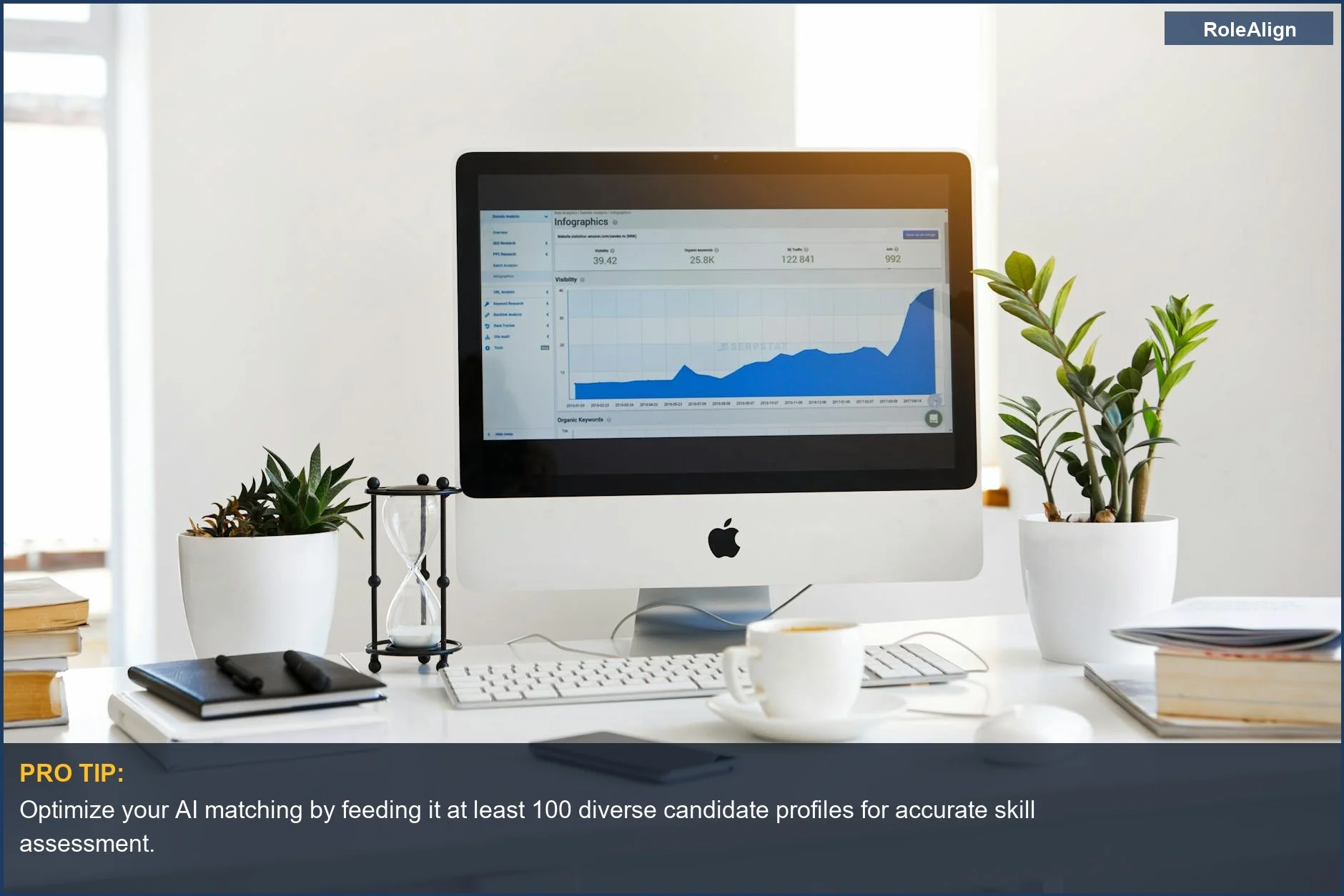
Optimize your AI matching by feeding it at least 100 diverse candidate profiles for accurate skill assessment.
Leverage AI-based matching in recruiting to transform your workspace into a hub of data-driven insights, streamlining candidate evaluation for efficiency. | Photo by Serpstat

What's Actually Going On

1
ATS parsing mechanics - Most Applicant Tracking Systems (ATS) aren't as smart as you think. They primarily parse resumes for keywords, dates, and company names. While some advanced systems use Natural Language Processing (NLP) to understand context, many still rely on simpler pattern matching. This means if your resume doesn't explicitly state the skills or experience listed in the job description, the ATS might filter you out before a human ever sees it. Tools like MokaHR are improving this by offering more sophisticated semantic understanding, aiming for over 90% accuracy in matching candidate suitability.
2
Recruiter screening reality - Recruiters are drowning in applications. For every open role, they might see hundreds, even thousands. They spend seconds, not minutes, on initial resume reviews. They're looking for immediate red flags or clear matches to the most critical requirements. They often scan for familiar company names, degrees from reputable institutions, and specific technical skills. This is where AI-based matching in recruiting starts to shine, reducing manual sourcing time by 38% according to some analyses.
3
Hiring committee decisions - Once a candidate passes the initial screen, they enter the hiring committee. This group is focused on team fit, long-term potential, and how the candidate's skills complement the existing team. They'll look at your project work, behavioral interview answers, and your ability to articulate your experience. This is where the nuance of your career story matters most, something AI is still learning to fully grasp. However, AI can surface candidates with the right core competencies, freeing up the committee to focus on these qualitative aspects.
4
Company size and industry impact - Startups often rely heavily on ATS and AI to manage volume with lean teams. They might use tools like Recruiterflow to quickly identify candidates with a broad range of skills. Enterprise companies, with more resources, might have more customized ATS configurations and sophisticated AI tools, aiming for predictive hiring and diversity metrics as seen with MokaHR. In tech, AI excels at matching coding languages and open-source contributions. In finance, it's about compliance and regulatory knowledge. Healthcare requires specific certifications and patient care experience, areas where AI can parse credentials effectively.
To grasp the full impact of these systems, it's essential to understand how AI screens your resume before reaching a recruiter.
Train your AI to recognize at least 5 common ATS parsing limitations for better candidate data accuracy.
AI-based matching in recruiting empowers recruiters to analyze complex data, moving beyond basic keyword parsing for deeper candidate understanding and insights. | Photo by ThisIsEngineering

How to Handle This

1
Configure your AI matching system - Before you even post a job, dive into your Applicant Tracking System (ATS) and ensure its AI matching capabilities are properly configured. This isn't just about keywords; advanced systems like MokaHR analyze skills, experience context, and even predict candidate suitability with over 90% accuracy MokaHR. If you skip this, you're essentially telling the AI to guess, leading to a flood of irrelevant candidates or missed gems. For senior roles, ensure the AI is trained to recognize nuanced leadership skills and strategic experience, not just technical proficiencies.
2
Prioritize AI-identified top candidates - Once your AI has done its initial screening, don't just glance at the results. Focus your immediate engagement efforts on the candidates the AI has ranked highest. These are the individuals the system has identified as the most closely aligned with the role's requirements, potentially saving you significant manual sourcing time. AI can reduce manual sourcing time by 38% daily.dev Recruiter. For high-volume roles, this means quickly identifying those with the core competencies, allowing you to move to personal outreach within a day or two. Skipping this means you're likely wasting time on candidates the AI already flagged as less suitable.
3
Use AI to uncover hidden talent - Leverage your AI matching system to revisit past applicants or explore your existing talent pool. AI can identify candidates who may have been overlooked previously due to keyword limitations or a slightly different skill set. This is crucial for roles where specific niche skills are required or for building a diverse pipeline. AI can uncover hidden talent by revisiting past applicants daily.dev Recruiter. If you skip this, you're missing out on potentially qualified individuals already in your system, which is especially detrimental for hard-to-fill positions. This proactive approach can drastically improve your time-to-hire, which AI automation can reduce by up to 63% MokaHR.
4
Supplement AI with human insight - Never rely solely on AI output. While AI offers impressive accuracy, it's a tool to augment, not replace, human judgment. Use AI-identified candidates as a starting point for your own deeper dive. For example, if the AI flags a candidate for a senior engineering role, you still need to assess their communication style and leadership potential through interviews. AI-driven shortlisting can reduce bias by up to 40% TalentAdore, but a final human review ensures a holistic fit. Skipping this human touch can lead to technically skilled but culturally misaligned hires.
To optimize your recruitment strategy, it's crucial to understand the pitfalls of misleading AI job postings, as discussed in this insightful article.
Configure your AI matching system with at least 3 key performance indicators to measure its effectiveness.
Unlock the power of AI-based matching in recruiting by configuring your systems for optimal performance, ensuring precision in candidate selection. | Photo by Tranmautritam

What This Looks Like in Practice

  • Senior Software Engineer at a Series B Startup AI excels at sifting hundreds of resumes for niche skills like Rust, Kubernetes, or specific ML frameworks. It correctly identified candidates with deep experience in distributed systems, even if their resumes weren't overtly "senior." It also surfaced candidates from less obvious backgrounds with relevant project work, combating the "only hire from FAANG" bias. However, some systems still struggle with context. An AI might over-rank a candidate with a strong theoretical ML background for a production-focused role, missing the nuance that real-world application is key for growth-stage companies. Recruiterflow Blog
  • Entry-Level Data Analyst at a Fortune 500 For large enterprises, AI is crucial for volume. It accurately filters for essential qualifications like SQL, Python, and basic statistical knowledge, freeing recruiters for cultural fit and potential. It ensures candidates meet minimum criteria before human review, vital for thousands of applicants. The pitfall? Over-reliance on exact keyword matches. Candidates listing "data manipulation" instead of "data wrangling" can be missed if the AI isn't configured for synonyms or implied skills. MokaHR
  • Career Changer from Teaching to Product Management AI is a double-edged sword here. Advanced NLP *can* flag transferable skills like "curriculum design" as similar to "product roadmap planning," identifying strong organizational and communication skills. It can suggest roles aligning with stated interests. The problem: most AI struggles translating non-traditional experience. A teacher's project management of school-wide initiatives might not register as relevant product management experience to an AI seeking Jira or Agile certifications. Human oversight is critical to recognize potential in career changers. daily.dev Recruiter
As AI reshapes recruiting, it also revolutionizes job searching, making it essential to explore how AI is transforming work.
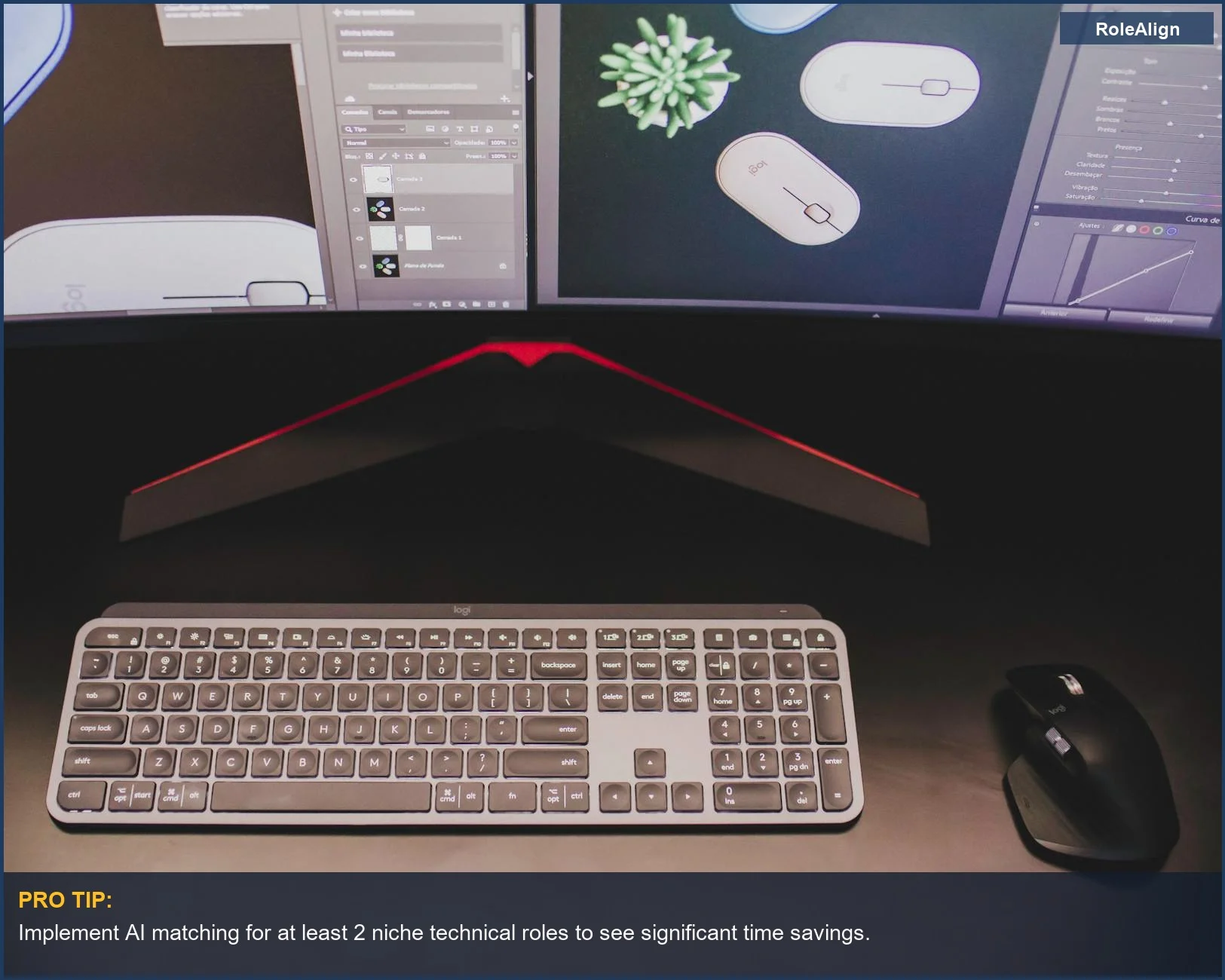
Implement AI matching for at least 2 niche technical roles to see significant time savings.
AI-based matching in recruiting excels at identifying niche technical skills, like Kubernetes, from hundreds of resumes, saving valuable recruiter time. | Photo by Matheus Bertelli

Mistakes That Kill Your Chances

Mistake Over-reliance on generic keywords.
Why candidates make it You're told to stuff your resume with every buzzword from the job description. It feels like the safer bet.
What recruiters actually see AI systems now go beyond basic keyword matching, using NLP to understand context. Stuffing too many disparate terms signals a lack of focus or an attempt to game the system, which can actually *lower* your match score. For senior roles, this makes you look unfocused; for new grads, it highlights a lack of deep understanding.
The fix Focus on high-impact keywords that genuinely reflect your core skills and achievements. Prioritize quality over quantity, ensuring every term adds meaningful context. AI talent matching systems analyze resumes and job descriptions to identify skills and potential traditional methods miss, so genuine skill representation is key daily.dev Recruiter.
Mistake Assuming AI is a magic bullet for career changers.
Why candidates make it You believe AI can bridge gaps by highlighting transferable skills, making your pivot seem seamless.
What recruiters actually see While AI can identify transferable skills, it struggles with nuanced career transitions unless explicitly trained for them. A resume that doesn't clearly articulate the *why* and *how* of a career change, even with keywords, can be misinterpreted. Recruiters see a mismatch between your stated experience and the target role's typical trajectory. For mid-career professionals, this is a significant hurdle.
The fix Explicitly address your career pivot in your summary or objective. Quantify how past experiences directly translate to the new role's requirements. Highlight specific projects or training that demonstrate your commitment and acquired skills for the new field.
Mistake Ignoring soft skills and cultural fit for technical roles.
Why candidates make it You assume AI-based matching for technical jobs is purely about coding languages and technical proficiencies.
What recruiters actually see Advanced AI systems, like those powering MokaHR, incorporate soft skills and cultural alignment into their matching algorithms. If your resume solely focuses on technical jargon and neglects collaboration, communication, or problem-solving examples, the AI may rank you lower for roles where these are critical. Recruiters want well-rounded candidates, not just code factories.
The fix Integrate soft skills into your experience descriptions using the STAR method. Instead of "managed a project," describe how you "collaborated with cross-functional teams to deliver a project on time, improving team communication by X%." AI can analyze these narrative elements to assess fit beyond technical skills.
Mistake Assuming AI always prioritizes diversity and inclusion.
Why candidates make it You believe AI inherently removes human bias and promotes a fair playing field.
What recruiters actually see AI can *reduce* unconscious bias, but it's only as unbiased as its training data. Historical hiring patterns can embed existing biases into the AI's decision-making. If past successful hires in a role were predominantly from a certain demographic, the AI might unconsciously favor similar profiles. MokaHR aims for diversity and inclusion, but this is an ongoing effort.
The fix Highlight unique experiences and perspectives that might not fit a narrow, traditional mold. Actively seek companies that publicly commit to and demonstrate diversity and inclusion initiatives in their hiring practices.
To enhance your job search strategy, consider exploring AI job search tools that can elevate your application process.
AI recruiting pros/cons comparison infographic.
Comparison overview for ai-based matching in recruiting

Key Takeaways

To further enhance your understanding, explore the Recruit CRM hiring process and its implications for candidates and recruiters.

Frequently Asked Questions

How does using AI in hiring actually speed things up for recruiters?
Think of it like this: instead of a human sifting through hundreds, sometimes thousands, of resumes for keywords, AI systems like those from MokaHR can screen applications with over 87% accuracy compared to manual reviews, cutting down screening time significantly. MokaHR also claims to reduce time-to-hire by up to 63% through automated workflows, freeing up recruiters to focus on interviewing actual promising candidates rather than just sorting paper.
What kinds of jobs seem to get the best results from AI candidate matching?
Tech and highly specialized roles are where these systems really shine. AI can dissect complex technical requirements and match them against candidate profiles with a precision that's hard for humans to replicate consistently, especially when dealing with niche skills or specific coding languages. Systems are designed to analyze GitHub contributions and career trajectories for developer roles, which is tough to do manually at scale.
Are there any job types where AI matching just doesn't work well?
Absolutely. If a role heavily relies on subjective qualities like creativity, emotional intelligence, or nuanced interpersonal skills - think sales, customer success, or creative arts - AI struggles. While some systems try to incorporate personality traits, they can't truly gauge cultural fit or soft skills the way an experienced human interviewer can. You're better off with human judgment for those.
How should I tweak my resume so that AI screening tools don't miss me?
The key is to be explicit. These systems, especially older Applicant Tracking Systems (ATS) that might have rudimentary AI, look for exact keyword matches from the job description. Don't get cute with synonyms; if the posting says 'project management,' use 'project management' on your resume, not just 'leading initiatives.' Make sure your skills section clearly lists the technologies and methodologies mentioned in the job ad. Qandle emphasizes that AI breaks down job requirements into structured skills, so mirroring that structure is smart.
What's the biggest risk of letting AI do all the heavy lifting in hiring?
The biggest pitfall is creating an echo chamber and missing out on diamonds in the rough. AI is only as good as the data it's trained on, and it can sometimes penalize candidates who don't fit a perfect, predefined mold, even if they possess transferable skills or immense potential. Recruiterflow points out that AI systems score candidates, but over-reliance can lead to overlooking unique talent that doesn't tick every single box perfectly.

Sources

Related Articles