How AI is Changing Recruiter Workflows Right Now (What Candidates Need to Know)
RoleAlign Team
17 min read
Includes Video
You just got another automated rejection email. Staring at your screen, you wonder if anyone actually *reads* your meticulously crafted resume anymore. The truth is, the hiring landscape has shifted dramatically, and it's not just about keywords. Recruiters are now leveraging sophisticated AI hiring tools to manage the sheer volume of applications and find the right talent at unprecedented speed.
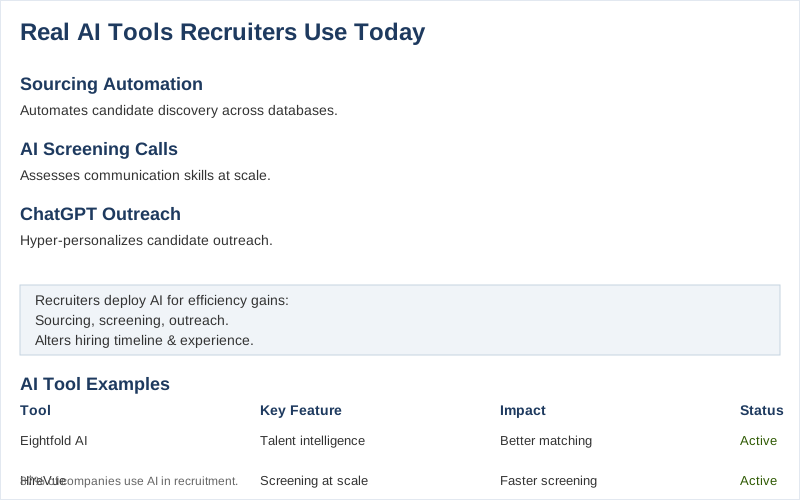
You just got another automated rejection email. Staring at your screen, you wonder if anyone actually reads your meticulously crafted resume anymore. The truth is, the hiring landscape has shifted dramatically, and it's not just about keywords. Recruiters are now leveraging sophisticated AI hiring tools to manage the sheer volume of applications and find the right talent at unprecedented speed. Forget the vague promises of "AI-powered" job boards; the real impact is happening behind the scenes. Recruiters are using AI for everything from automating the initial sourcing of candidates across vast databases to conducting AI-powered screening calls that assess communication skills. Tools like Eightfold AI are transforming talent intelligence, while platforms like HireVue are handling early-stage screening at scale Leonar. Even ChatGPT is being deployed by recruiters for hyper-personalized outreach, moving beyond generic templates. This isn't the future; it's how hiring works today, with 87% of companies now using AI in their recruitment processes Joveo. Understanding these AI hiring tools recruiters use is no longer optional for candidates; it's essential.
These advanced platforms are fundamentally reshaping how talent acquisition operates. Sourcing automation, for instance, goes far beyond simple keyword searches. AI tools like Eightfold AI Juicebox and Recruiterflow Recruiterflow can analyze millions of profiles across various platforms, identifying passive candidates with precise skill sets and potential cultural fits that human recruiters might miss. This significantly broadens the talent pool and reduces the time spent on manual candidate discovery. Furthermore, AI-powered screening calls, exemplified by HireVue Joveo, are revolutionizing the initial stages of the hiring process. These systems can conduct asynchronous interviews, evaluating not only a candidate's responses but also their communication style, confidence, and problem-solving abilities through video and sometimes even text-based interactions. This not only speeds up the screening process, allowing recruiters to focus on more qualified individuals, but also standardizes the initial assessment, aiming for greater objectivity. The impact on hiring speed is profound, with some platforms promising to cut hiring time by 40-50% Homans. The use of ChatGPT for outreach personalization means recruiters can generate tailored messages that resonate with individual candidates, increasing engagement rates and improving the candidate experience by making them feel genuinely seen and valued, rather than just another applicant in a large pool. This strategic deployment of AI is transforming recruitment from a reactive, labor-intensive task into a proactive, data-driven, and efficient operation.
Key specifications for The real AI tools recruiters are using today (not candidates), including sourcing automation, AI-powered screening calls, ChatGPT for outreach personalization, and the measurable impact on candidate experience and hiring speed.
The Real Answer
Recruiters are deploying AI not for candidate convenience, but for unprecedented efficiency gains in sourcing, screening, and outreach, fundamentally altering the hiring timeline and candidate experience.
Forget the candidate-centric AI hype; the real revolution is happening behind the recruiter's screen. Today's AI tools are laser-focused on automating repetitive, high-volume tasks that used to bog down talent acquisition teams. Think of it as a turbocharged assistant that never sleeps. Platforms like HeyMilo and Fetcher are streamlining the initial pipeline build. Recruiters are leveraging AI sourcing agents to automatically discover and shortlist candidates from vast databases, moving beyond basic keyword searches to understand nuanced skill sets. This allows them to focus on engagement rather than endless scrolling.
The next major AI application is in screening at scale. Tools like HireVue are integral to this, using AI for initial interview assessments and screening calls, especially for high-volume roles. This isn't about replacing human judgment entirely, but about filtering out unqualified applicants efficiently. A staggering 98% of companies reported significant improvements in hiring efficiency, including resume screening and skill assessment, thanks to AI in 2025 Insight Global. This means faster initial feedback loops, but also potentially fewer candidates making it through the first AI gatekeeper.
For outreach, recruiters are using generative AI like ChatGPT to personalize communication at scale. Instead of generic templates, AI can help craft tailored messages based on a candidate's profile and the specific job requirements, significantly boosting response rates. This is about making outreach feel more human, even when automated. The adoption of Gen AI tools among recruiting teams is growing, with 37% of organizations actively integrating or experimenting with them LinkedIn. While this can improve the candidate experience by providing more relevant communication, it also means candidates are likely interacting with AI-generated content more frequently than they realize.
The measurable impact is undeniable: reduced time-to-fill and a more efficient, albeit sometimes less personal, candidate journey. The AI hiring tools recruiters use today are designed for speed and volume, transforming workflows and setting new expectations for hiring velocity.
Discover how AI hiring tools are revolutionizing recruiter workflows, delivering unprecedented efficiency and a faster path to hire. See the measurable impact today.
| Photo by Serpstat
Discover how AI hiring tools are revolutionizing recruiter workflows, delivering unprecedented efficiency and a faster path to hire. See the measurable impact today.
| Photo by Serpstat
What's Actually Going On
1
Sourcing automation is where AI first truly disrupted recruiter workflows. Forget manually sifting through LinkedIn or job boards for hours. Tools like Fetcher and Eightfold AI compare the 13 best AI recruiting tools by proactively identifying and even reaching out to passive candidates based on defined criteria. These platforms move beyond simple keyword matching, understanding context and intent to deliver qualified talent pools. This means AI can analyze vast datasets of professional profiles, identifying individuals whose skills, experience, and even career aspirations align with a specific role, often uncovering candidates that a human recruiter might miss. Eightfold AI, for instance, acts as a comprehensive talent intelligence platform, leveraging machine learning to manage the entire recruitment process and identify suitable candidates for large organizations Best AI Recruiting Tools for 2026: Complete Guide - HeyMilo, 21 Best AI Recruiting Tools of 2026 - Recruiterflow Blog. These tools can also be programmed to run searches on a schedule, delivering a daily digest of potential candidates, significantly reducing the manual effort involved in initial candidate identification.
2
AI-powered screening calls are the next frontier. Platforms such as HireVue use AI to conduct initial screenings at scale, often through asynchronous video or conversational AI interfaces. This isn't about replacing human judgment entirely, but about handling the high-volume, repetitive tasks that consume recruiter time. The goal is to quickly assess basic qualifications and cultural fit before a human recruiter invests significant time. This efficiency is crucial, with 98% of organizations reporting significant improvements in hiring efficiency via AI in areas like screening resumes and assessing skills 2025 AI in Hiring Survey Report. HireVue specifically focuses on early-stage screening at scale, utilizing AI for interview workflows and assessments 11 Top AI Recruiting Tools for 2026. These AI-driven interactions can ask standardized questions, analyze responses for keywords and sentiment, and even assess non-verbal cues in video interviews, providing a preliminary score to recruiters. This frees up recruiters to concentrate on more complex candidate interactions and strategic talent acquisition initiatives.
3
ChatGPT for outreach personalization is a significant development. Recruiters are leveraging LLMs like ChatGPT to craft tailored outreach messages, making them sound more human and relevant to individual candidates. This moves beyond generic templates, increasing engagement rates. When you describe what you need, the tool delivers a shortlist, and some even run searches on a schedule, sending candidates daily 13 Best AI Recruiting Tools in 2026 (Compared). Instead of sending the same message to dozens of potential hires, recruiters can use AI to quickly generate personalized introductions that reference a candidate's specific skills, projects, or professional achievements, demonstrating that the outreach is not a mass-produced email but a thoughtful invitation. This level of personalization significantly boosts the chances of a positive response and can make a candidate feel genuinely valued.
4
The impact on candidate experience is nuanced. While AI can speed up processes and provide quicker initial responses, the quality of that interaction is paramount. Companies are seeing benefits; around 87% of companies now use AI in their recruitment processes 11 Top AI Recruiting Tools for 2026. However, poorly implemented AI can feel impersonal and frustrating, leading to a negative candidate experience. For instance, an AI chatbot that provides canned, unhelpful answers or an automated rejection email that lacks any personalization can alienate candidates. Conversely, when AI is used to augment human recruiters, such as by providing them with better candidate insights or automating tedious administrative tasks, it can lead to a more efficient and positive experience for all involved. The key is to ensure AI enhances, rather than replaces, the human touch where it matters most.
5
Hiring speed is demonstrably improving. AI recruiting tools are being applied across various workflows, from sourcing and matching to engagement and screening. This automation helps reduce the time-to-fill on positions, a critical metric for businesses. Many teams report significant time savings and faster screening as key benefits of integrating AI 11 Top AI Recruiting Tools for 2026. Some platforms even claim to cut hiring time by 40-50% 15+ Best AI Recruiting Tools (2026): Reviews, Pricing & ROI Guide. By automating repetitive tasks, AI allows recruiters to focus on building relationships, conducting in-depth interviews, and making informed hiring decisions, ultimately accelerating the entire recruitment lifecycle. The ability to quickly identify, screen, and engage with a larger pool of qualified candidates directly translates into faster time-to-hire, which is a significant competitive advantage in today's talent market.
To grasp the full impact of these systems, it's essential to understand how AI screens your resume before reaching a recruiter.
AI hiring tools are streamlining the initial sourcing stage, allowing recruiters to focus on strategic outreach and engagement with top talent.
| Photo by RDNE Stock project
AI hiring tools are streamlining the initial sourcing stage, allowing recruiters to focus on strategic outreach and engagement with top talent.
| Photo by RDNE Stock project
How to Handle This
1
Automated Sourcing with AI Agents - Recruiters use AI sourcing agents, like Eightfold AI Eightfold AI, to describe ideal candidates and have the AI deliver a daily shortlist. This dramatically reduces the hours spent manually searching LinkedIn Recruiter or internal databases, which is crucial for roles requiring niche skills or high-volume hiring 13 Best AI Recruiting Tools in 2026 (Compared) | Leonar. Skipping this means recruiters are stuck with the old, time-consuming search methods, leading to slower time-to-fill and potentially missed passive candidates. For senior or specialized roles, this AI-driven sourcing is often the *only* way to find qualified individuals who aren't actively looking. These platforms leverage machine learning to analyze vast datasets, identifying individuals whose skills, experience, and even career trajectory closely match the defined requirements 21 Best AI Recruiting Tools of 2026 - Recruiterflow Blog. This proactive approach ensures that recruiters are presented with a curated list of potential hires, rather than sifting through countless irrelevant profiles. The impact on efficiency is substantial, freeing up recruiters to focus on relationship building and candidate engagement rather than the laborious initial search. For instance, a recruiter looking for a highly specialized AI engineer with experience in a specific programming language and a background in a particular industry can have an AI agent generate a list of qualified candidates within hours, a task that could previously take days or even weeks. This precision in sourcing not only speeds up the hiring process but also improves the quality of candidates entering the pipeline, ultimately leading to better hires. Eightfold AI, for example, is a comprehensive talent intelligence platform designed for large enterprises, streamlining both external recruitment and internal talent management 7 Best AI Recruitment Tools to Find Top Talent (2026 Guide).
2
AI-Powered Screening Calls & Assessments - Platforms like HireVue use AI to conduct initial screening calls and skills assessments, particularly for high-volume roles or early-stage screening 11 Top AI Recruiting Tools for 2026 | Top Hiring Platforms Reviewed. The AI analyzes candidate responses for key competencies and cultural fit, flagging candidates for human review. If this step is skipped, recruiters are bogged down with unqualified applicants, wasting valuable time on interviews that go nowhere. This is especially prevalent in industries with high turnover, like customer service or retail, where AI handles the initial deluge of applications efficiently. These AI systems can evaluate not only verbal responses but also non-verbal cues, providing a more holistic initial assessment. By automating these initial stages, recruiters can dedicate more time to in-depth interviews with genuinely promising candidates, significantly improving the overall quality of the hiring process. For roles demanding specific technical skills, AI-powered assessments can objectively measure proficiency, removing human bias and ensuring a standardized evaluation. This not only accelerates the time-to-hire but also enhances the candidate experience by providing prompt feedback and reducing the waiting period for applicants. HireVue, a prominent player in this space, applies AI to interview workflows and assessments, focusing on early-stage screening at scale 11 Top AI Recruiting Tools for 2026 | Top Hiring Platforms Reviewed. This efficiency translates directly into a better candidate experience, as applicants receive quicker responses and are only moved forward if they meet the basic qualifications.
3
ChatGPT for Personalized Outreach - Recruiters leverage ChatGPT to draft personalized outreach messages, tailoring them based on candidate profiles and specific role requirements. This moves beyond generic copy-paste emails, increasing response rates. For instance, a recruiter might ask ChatGPT to draft a LinkedIn message highlighting how a candidate's experience with Python aligns with a specific project mentioned in their profile. Neglecting this means candidates receive bland, uninspired messages that are easily ignored. For tech roles, where candidates are often bombarded with messages, personalization is key to getting noticed. AI tools like ChatGPT can analyze a candidate's LinkedIn profile, resume, or even public professional contributions to identify unique selling points that can be woven into the outreach message. This level of personalization demonstrates to the candidate that the recruiter has taken the time to understand their background and is genuinely interested in their potential fit for the role. The measurable impact is a significant increase in response rates, as personalized messages are far more likely to capture a candidate's attention and encourage them to engage. This is particularly critical in competitive talent markets where top candidates have multiple opportunities. By using AI to craft these tailored messages, recruiters can effectively cut through the noise and establish a more meaningful connection with potential hires, leading to a more positive candidate experience and a faster path to filling critical positions. This strategic use of AI ensures that outreach is not just about volume, but about thoughtful engagement.
AI-powered sourcing agents are transforming recruiter workflows by automating initial candidate identification and outreach, speeding up the hiring process significantly.
| Photo by BOOM 💥 Photography
AI-powered sourcing agents are transforming recruiter workflows by automating initial candidate identification and outreach, speeding up the hiring process significantly.
| Photo by BOOM 💥 Photography
What This Looks Like in Practice
AI-Powered Sourcing Agents Automate Initial Outreach A Senior Software Engineer at a Series B Startup found that AI sourcing tools like Fetcher significantly cut down the time spent on manual candidate searches. Instead of sifting through hundreds of LinkedIn profiles, the recruiter described the ideal candidate using natural language prompts. The AI then generated a curated shortlist of passive candidates, often flagging individuals with niche skill sets that might have been missed. This freed up significant time for more strategic engagement.
AI Screening Calls Handle High-Volume Roles For an Entry-Level Data Analyst position at a Fortune 500 company, AI-powered screening tools like HireVue were deployed. These platforms automate initial screening calls, asking pre-set questions and assessing candidate responses for key competencies. This process drastically improved efficiency for roles with a high volume of applicants, ensuring that only qualified candidates moved to the next stage. While effective for initial filtering, recruiters noted that complex behavioral questions still required human interaction.
ChatGPT for Personalized Outreach Messages A Career Changer from Teaching to Product Management experienced recruiters using ChatGPT to personalize outreach messages. Instead of generic templates, recruiters used the LLM to draft messages that referenced specific projects or skills from the candidate's profile, making the outreach feel more relevant. This led to higher response rates and a more positive initial candidate experience, as it demonstrated a recruiter had actually reviewed their background.
AI Talent Intelligence Platforms for Internal Mobility Large enterprises are leveraging platforms like Eightfold AI to map internal skills to open roles. This AI hiring tool not only helps in finding external talent but also identifies existing employees who are a good fit for new positions, boosting internal mobility and retention. Recruiters report this enhances workforce planning and reduces the time-to-fill for critical roles by leveraging their existing talent pool.
To enhance your job search experience, consider leveraging innovative AI job search tools that streamline the process.
Explore the technology behind AI resume screening, how it works to identify top candidates, and its impact on hiring speed and quality.
| Photo by Johannes Plenio
Explore the technology behind AI resume screening, how it works to identify top candidates, and its impact on hiring speed and quality.
| Photo by Johannes Plenio
Mistakes That Kill Your Chances
Mistakes That Kill Your Chances
You think a perfectly crafted resume, crammed with buzzwords, is your golden ticket. You believe meticulously detailing every project, no matter how minor, will impress. You're convinced generic cover letters, slightly tweaked, are sufficient. These tired tactics used to work, but they're now actively working against you in an AI-driven recruiting landscape. Recruiters aren't just skimming; they're leveraging AI hiring tools that process thousands of applications in minutes. Your prose might be getting lost before a human even sees it.
Symptom Your application disappears into a black hole, with no response for weeks or months.
Signal Your application status never updates beyond "Received" or "Under Review" in the applicant tracking system (ATS).
Fix Focus on quantifiable achievements and keywords that directly match the job description. Use tools like Eightfold AI juicebox.AI to understand common industry language and tailor your resume accordingly.
You believe your senior leadership experience automatically translates into a perfect fit for every role, and you don't bother to tailor your application beyond a cursory mention of "leadership." You assume recruiters will see the brilliance of your decades of experience without you explicitly connecting it to their specific needs. This is a critical misstep. AI resume screening tools are trained to identify precise skill matches and experience alignment. They flag candidates who demonstrate a clear understanding of the role's requirements, not just those who have held senior positions.
Symptom You're consistently overlooked for senior-level roles despite a strong track record.
Signal Your applications are frequently rejected at the initial screening stage, often without a personalized rejection.
Fix For senior roles, explicitly detail how your past accomplishments directly address the *specific challenges* of the target role. Recruiters use AI to match impact, not just titles. Reference specific tools or methodologies mentioned in the job description if your experience aligns.
You're convinced using ChatGPT for outreach or your resume will give you an edge, making your application seem polished or your contact more engaging. You might think, "Why wouldn't a recruiter appreciate a well-written, AI-assisted message?" The harsh reality is that many recruiters are now using AI to *detect* AI-generated content. They're looking for genuine human connection and unique insights. Over-reliance on LLMs for personalization can backfire, making your outreach feel hollow and your resume appear inauthentic, leading to immediate disqualification. business with LinkedIn reports that 37% of organizations are actively integrating or experimenting with Gen AI tools, and this includes detection.
Symptom Your personalized outreach emails or messages are ignored, or worse, met with suspicion.
Signal A low response rate to your direct messages or application follow-ups.
Fix Use AI tools like ChatGPT for *idea generation* or *drafting initial outlines*, but always inject your authentic voice and specific experiences. Recruiters value genuine, human-crafted communication. Never submit content that hasn't been thoroughly reviewed and personalized by you.
You assume every AI tool is the same and that using any AI-powered resume builder or job board will automatically optimize your application. You don't differentiate between tools that genuinely enhance the hiring process and those that are simply repackaging basic automation. This is a costly mistake. Recruiters are increasingly using sophisticated platforms like HireVue Top Hiring Platforms Reviewed for early-stage screening at scale. Generic AI assistance won't pass muster.
Symptom You're applying to many jobs but getting very few interviews, even for roles you feel qualified for.
Signal High application volume but extremely low conversion rate to interviews.
Fix Research the specific AI tools companies in your target industry are using. Understand that AI is not a monolith; different tools excel at different tasks, from sourcing automation to interview screening. Tailor your approach based on this knowledge.
To improve your chances, consider how AI tools are reshaping the job application process in our article on AI job search.
Key Takeaways
The AI hiring tools recruiters use today are transforming workflows by automating tedious tasks and surfacing relevant candidates faster. Expect to see AI in sourcing automation, AI-powered screening calls, and even ChatGPT for personalized outreach. This shift is driven by a need for efficiency, with 98% seeing improved hiring efficiency through AI for tasks like scheduling and resume screening Insight Global.
Tools like Eightfold AI and HireVue are staples for large enterprises, focusing on talent intelligence and early-stage screening at scale Juicebox, Globalify. AI sourcing agents can now deliver shortlists with minimal input, evolving beyond simple keyword searches to understand context and concepts, significantly reducing time spent on manual prospecting Leonar.
The impact on candidate experience is mixed. While faster screening can be positive, the increasing use of AI resume screening means candidates need to be precise with keywords and clear about their skills. The goal for recruiters is to reduce noise and highlight meaningful signals, not just move faster Joveo.
The most important thing a recruiter would tell you off the record? "We're already using AI to filter you. If your resume isn't optimized for the ATS and clearly states your relevant skills and achievements, you might not even get seen by a human."
To better understand how AI impacts recruiting, explore the process behind modern talent sourcing.
Frequently Asked Questions
What AI tools are recruiters *actually* using to find candidates these days?
Forget fancy buzzwords; recruiters are leaning heavily into AI for sourcing automation. Tools like Fetcher, Eightfold AI, and even more integrated platforms within ATS systems are used to scan vast databases and the open web for passive candidates. They're designed to identify individuals who fit specific skill sets and experience profiles, often flagging them before they even apply, which drastically cuts down manual search time. Some systems can even learn from your past successful hires to refine future searches.
I keep hearing about AI screening calls. How does that work for recruiters, and what should I expect?
AI-powered screening calls are a reality, primarily for high-volume roles or early-stage filtering. Platforms like HireVue and Paradox (Olivia) use AI to conduct initial interviews, asking standardized questions and analyzing responses for keywords, sentiment, and even non-verbal cues. For you, this means you might have a recorded video interview or a chatbot interaction before speaking to a human. Recruiters use this to quickly assess basic qualifications and fit, saving them hours of repetitive first-round conversations.
Is ChatGPT really being used by recruiters for sending emails?
Absolutely. Recruiters are leveraging ChatGPT and similar generative AI for outreach personalization. Instead of generic templates, they can feed it a candidate's profile and the job description, asking it to draft a compelling, tailored message highlighting why the role is a good fit. This helps them craft more engaging outreach that feels less like a mass email, significantly improving response rates and saving them time on writing.
What's the actual impact of these AI hiring tools on candidate experience?
The impact is a mixed bag, honestly. On the plus side, AI can speed up the process, meaning you get feedback faster and don't languish in limbo. Tools that automate scheduling or provide quick initial screening responses can make the process feel more efficient. However, if not implemented thoughtfully, it can feel impersonal, like you're just interacting with a bot. The best AI tools aim to *augment* the recruiter, not replace them, freeing them up for more meaningful candidate interactions.
How much faster are companies hiring with these AI recruiting tools?
We're seeing significant reductions in time-to-fill. Reports indicate that AI can cut hiring time by 40-50% in many cases, with some companies seeing efficiency gains of up to 98% in areas like scheduling and screening [15+ Best AI Recruiting Tools (2026): Reviews, Pricing & ROI Guide](https://homans.AI/blog/15-best-AI-recruiting-tools-2026-reviews-pricing-ROI-guide/). This is largely due to automating repetitive tasks, allowing recruiters to focus on engaging with qualified candidates and making faster decisions, rather than wading through endless applications.
Are recruiters using AI to screen resumes, and how does that work?
Yes, AI resume screening is a huge part of what recruiters do now. Tools integrated into Applicant Tracking Systems (ATS) or standalone platforms analyze resumes for keywords, skills, experience, and qualifications against job requirements. I've configured ATS systems myself, and the AI goes beyond simple keyword matching; it can understand context and rank candidates based on how closely they align with the ideal profile. This helps recruiters quickly identify the top contenders from a large applicant pool, often filtering out those who don't meet minimum criteria.
What's the ROI for companies investing in AI for recruiting in 2025?
The ROI is substantial, primarily driven by efficiency and speed. Companies are seeing significant improvements in hiring speed, with many reporting reductions of 40-50% in time-to-fill [15+ Best AI Recruiting Tools (2026): Reviews, Pricing & ROI Guide](https://homans.AI/blog/15-best-AI-recruiting-tools-2026-reviews-pricing-ROI-guide/). Beyond speed, AI reduces the cost per hire by automating tasks that would otherwise require significant recruiter hours. Given that 87% of companies now use AI in recruitment, the market is clearly demonstrating its value [11 Top AI Recruiting Tools for 2026 | Top Hiring Platforms Reviewed](https://www.joveo.com/blog/top-AI-recruiting-tools/).
Are AI interview screening tools like HireVue actually used by recruiters?
Definitely. HireVue is a prime example of an AI hiring tool recruiters use for early-stage screening at scale [11 Top AI Recruiting Tools for 2026 | Top Hiring Platforms Reviewed](https://www.joveo.com/blog/top-AI-recruiting-tools/). They employ AI to manage interview workflows and assessments, often handling initial candidate evaluations through asynchronous video interviews or conversational AI. Recruiters rely on these tools to quickly filter candidates based on predefined criteria and behavioral assessments before dedicating human resources to later stages.