Making a Career Change at 40 Years Old: Practical Strategies for Success
RoleAlign Team
12 min read
Includes Video
You've just seen the email: "Thank you for your interest, but we've decided to move forward with other candidates." Another rejection. You're 40, maybe even a bit older, and the career you've dedicated years to no longer fits. The thought of starting over feels monumental, especially when you see younger professionals landing roles you're qualified for.
You've just seen the email: "Thank you for your interest, but we've decided to move forward with other candidates." Another rejection. You're 40, maybe even a bit older, and the career you've dedicated years to no longer fits. The thought of starting over feels monumental, especially when you see younger professionals landing roles you're qualified for. But here's the truth: making a career change at 40 years old is not only possible, it's becoming increasingly common. In fact, nearly 50% of professionals aged 40-45 are exploring new roles for better pay, purpose, and flexibility, according to UniAthena's 2025 outlook UniAthena. You're not starting from scratch; you're leveraging decades of experience, a clarity younger professionals often lack, and a deep understanding of what you don't want. This clarity is your superpower. As Forbes points out, career change at 40 is doable, and the most critical step is recognizing the wealth of knowledge you already possess Forbes. The challenge isn't your age; it's your strategy.
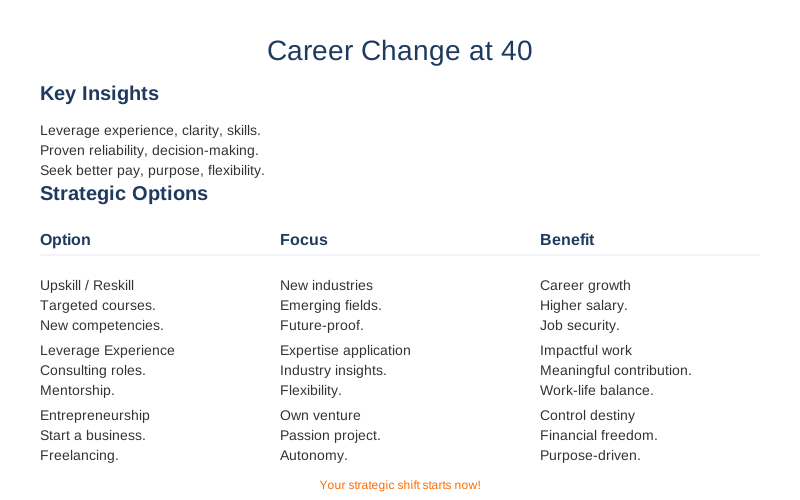
Key specifications for career change 40 years old
The Real Answer
Making a career change at 40 isn't about starting over; it's about strategically leveraging decades of acquired experience, clarity, and refined skills. Recruiters see your age not as a barrier, but as a sign of proven reliability and decision-making capability, especially for roles demanding leadership and stability.
The notion that you're "too old" to switch careers after 40 is a myth perpetuated by outdated thinking. In reality, nearly 50% of professionals aged 40-45 are actively exploring new roles for better pay, purpose, and flexibility UniAthena. Companies actively seek mid-career professionals for their leadership, communication, and decision-making prowess-qualities honed over years of navigating complex professional environments UniAthena.
Your **clarity about what you *don't* want** is a superpower. This self-awareness, absent in younger professionals, allows you to target roles that are genuinely aligned with your values and energy levels, leading to more successful and sustainable career shifts. It's about recognizing how your existing skills translate; for instance, a therapist's deep understanding of human behavior can be invaluable in leadership consulting Gail Golden Consulting.
The key is to empower yourself with a realistic understanding of your transferable skills and to actively research market demands. Before jumping into any changes, make sure you research the market and the job requirements Reddit. Focus on how you continuously learn and grow, and importantly, build your multigenerational network to gain insights from both experienced professionals and those earlier in their careers Gail Golden Consulting.
Consider high-growth sectors like data analytics and cybersecurity, where demand is surging. For example, countries like the US, UK, Canada, UAE, Singapore, and Australia report a 30-35% rise in demand for data analystsUniAthena. Your decades of experience are not a liability; they are your most significant asset in a career change at 40.
Learning is lifelong. At 40, embracing adult education like this woman can open doors to exciting new career paths, proving age is just a number.
| Photo by RDNE Stock project
Learning is lifelong. At 40, embracing adult education like this woman can open doors to exciting new career paths, proving age is just a number.
| Photo by RDNE Stock project
What's Actually Going On
1
ATS parsing and recruiter screening - Forget the romanticized idea of a recruiter poring over your resume. Most initial screens happen via Applicant Tracking Systems (ATS). These systems parse your resume for keywords, skills, and experience directly matching the job description. If your resume is formatted poorly, uses unusual fonts, or lacks precise terminology, the ATS might reject you before a human ever sees it. Recruiters then spend seconds scanning for those ATS-flagged keywords and a few key indicators of fit. They're eliminating candidates who don't immediately scream "match."
2
Hiring committee decisions - Once past the initial screen, your application lands with a hiring manager and potentially team members. They're looking for evidence of problem-solving ability, not just a list of past duties. They assess your experience against the specific needs of their team and the company's strategic goals. This is where your ability to articulate how your past experience translates to future success becomes critical. They want to see that you understand their challenges and can contribute solutions.
3
Company size and industry nuances - The hiring process varies significantly. Startups often have more agile, less structured processes, prioritizing raw talent and adaptability. Enterprise companies, conversely, have more formalized processes and stricter ATS filtering. In tech, a portfolio of projects or demonstrable coding skills can often outweigh formal experience. In finance, regulatory knowledge and a track record of stability are paramount. Healthcare demands strict adherence to protocols and specific medical or administrative qualifications.
4
Seniority level impact - For entry-level roles, companies might be more forgiving of a lack of direct experience if you demonstrate strong foundational skills and a clear learning trajectory. For mid-career to senior roles, they expect you to hit the ground running. Your ability to lead teams, manage complex projects, and drive strategic initiatives is scrutinized. A career change at 40 means you possess decades of experience, which is an asset. UniAthena highlights that nearly 50% of people aged 40-45 are exploring new roles for better pay, purpose, and flexibility.
5
Data-driven hiring insights - Research consistently shows that experience is transferable. Gail Golden Consulting emphasizes identifying how your skills are relevant to your new career and building a multigenerational network. LinkedIn data often points to the value of transferable skills and strategic networking. Companies increasingly look for candidates who can demonstrate continuous learning and adaptability, especially in fields like data analysis. For instance, countries like the US, UK, Canada, UAE, Singapore, and Australia report a 30-35% rise in demand for data analysts, with major firms posting record openings.
If you're also considering a career shift at a younger age, our article on career change at 30 offers valuable insights.
Don't let age be a barrier to tech. This gentleman's journey shows how acquiring computer skills can be a crucial step in a 40-year-old's career pivot.
| Photo by Kampus Production
Don't let age be a barrier to tech. This gentleman's journey shows how acquiring computer skills can be a crucial step in a 40-year-old's career pivot.
| Photo by Kampus Production
How to Handle This
1
Map your transferable skills - Recruiters scan for relevance. At 40, your resume is a treasure trove of experience. Identify how your existing skills directly map to the new role. Project management experience from a non-profit translates to stakeholder management and delivery oversight in tech. Acknowledging this upfront shows you've done your homework. Gail Golden Consulting emphasizes identifying how your skills are relevant to your new career, covering both hard and soft skills.
Skipping this means your application lands in the 'generic' pile. Recruiters see unrelated past jobs and assume you lack foundational abilities. They'll move on to candidates whose resumes scream "I can do this job" immediately.
2
Targeted Upskilling and Certifications - The market evolves. For a career change at 40, especially into fields like AI or data analysis, showing you've invested in current skills is critical. Recruiters look for tangible proof of learning. Pursuing a certification in Python via Coursera or a cloud platform like AWS demonstrates commitment and current competency. This is vital for roles where specific technical proficiencies are non-negotiable.
If you skip upskilling, your application appears outdated. A lack of recent, relevant training signals you haven't kept pace with industry demands. Recruiters might flag this as a significant gap, especially against candidates with recent credentials.
3
Strategic Networking, Not Just Sending Resumes - Recruiters are overwhelmed. A referral or introduction from a trusted contact cuts through the noise. At 40, you likely have a robust network. Leverage it by reaching out to individuals in your target industry or role. Aim for informational interviews for insights and potential introductions. Gail Golden Consulting highlights building a multigenerational network.
Ignoring networking means your application is just another data point in an ATS like Workday or Greenhouse. Recruiters prioritize candidates sourced through referrals because they've passed initial vetting. Without connections, your resume might never reach a human reviewer, especially for mid-level to senior roles where relationships matter.
4
Craft a Narrative, Not Just a Job History - Recruiters assess potential and fit. Your career change at 40 is a story of growth and strategic redirection. Frame your resume and cover letter to tell this story. Explain *why* you're changing, *what* you've done to prepare, and *how* your unique blend of experience and new skills makes you an ideal candidate. This narrative is crucial for leadership or client-facing roles.
Failing to craft this narrative results in a resume that reads like a chronological list of unrelated jobs. Recruiters will struggle to understand your motivation and future trajectory, questioning your commitment. This lack of clarity can be a deal-breaker.
To further enhance your transition, explore our comprehensive career change advice for navigating this significant life shift.
Engaging in modern learning environments is key. These seniors are actively building skills, a vital part of a successful career change for those over 40.
| Photo by Kampus Production
Engaging in modern learning environments is key. These seniors are actively building skills, a vital part of a successful career change for those over 40.
| Photo by Kampus Production
What This Looks Like in Practice
Educator to Tech PM. Sarah, an educator, found her curriculum development and assessment skills transferable to software project management. She leveraged her network to connect with a tech product manager, who mentored her on Agile. Sarah earned a PMP certification and volunteered in project coordination roles to build a portfolio. Her main hurdle was convincing hiring managers of her adaptability to a new industry, which she overcame by showcasing tangible project successes from her volunteer work. Forbes
Retail Management to Data Analysis. Mark, a retail manager experienced in inventory and sales forecasting, pivoted to data analysis, recognizing the demand for data-driven insights. He enrolled in online courses for Python and SQL, supplementing with personal projects analyzing public retail sales data. His demonstrated ability to extract actionable insights from complex datasets, even in a different context, proved effective. He underestimated the time for deep learning and the competitiveness of entry-level roles, leading to initial rejections. Career Change at 40 and Beyond: A Guide to Starting Fresh
Finance to UX Design. Maria, a financial analyst seeking a more creative role, identified UX design as a field where her analytical skills could be applied to understanding user behavior. She attended bootcamps and participated in design challenges and online communities. Her strength was translating complex requirements into user flows, a skill honed in finance. Overcoming the perception of lacking formal design training, she built a strong portfolio showcasing her problem-solving approach and user empathy. Career change after 40? Here are 5 key points to consider
Law to Cybersecurity. David, a lawyer, saw the increasing need for cybersecurity professionals and the overlap with risk assessment and regulatory compliance skills. He pursued cybersecurity certifications and networked actively. His legal background was invaluable for understanding compliance frameworks and data privacy, which were in demand. The challenge was demonstrating practical technical skills, which he addressed by building a home lab and contributing to open-source security projects. Career Change at 40: The 2026 Guide to High-Pay Pivots
Collaboration fuels innovation. Diverse teams and open discussion, like these colleagues, are essential for navigating a career change in your 40s and beyond.
| Photo by Edmond Dantès
Collaboration fuels innovation. Diverse teams and open discussion, like these colleagues, are essential for navigating a career change in your 40s and beyond.
| Photo by Edmond Dantès
Mistakes That Kill Your Chances
Mistake Treating years of experience as a liability.
Why candidates make it Fear age or lack of direct experience makes them seem overqualified or too expensive. They worry about starting from scratch.
What recruiters actually see Recruiters see you underestimating your value. They might also see someone who hasn't clearly articulated how existing skills translate, making you seem like a risk. This is a missed opportunity to highlight transferable strengths.
The fix Actively identify transferable skills (problem-solving, project management, communication) and map them to the new role's requirements. Frame your experience as a source of stability, leadership, and decision-making, qualities employers seek in mid-career professionals according to UniAthena. Recognize nearly 50% of people aged 40-45 explore new roles for better pay and purpose UniAthena.
Mistake Believing you need to start over or take a significant pay cut.
Why candidates make it The traditional career ladder implies starting at the bottom when changing industries. Fear of financial instability leads to this assumption.
What recruiters actually see Recruiters see a candidate who may lack confidence or hasn't done sufficient research. They also see someone who might be difficult to negotiate with if they're undervaluing themselves. This perpetuates the myth that a career change at 40 means starting from scratch.
The fix Your decades of experience and clarity on what you *don't* want are invaluable assets Turing College. Focus on how existing skills leverage entry into a new field at a higher level, or at least with a strong starting point. Companies often prefer mid-career professionals for roles demanding leadership and reliability UniAthena.
Mistake Over-indexing on new technical skills without understanding market demand.
Why candidates make it The allure of trendy tech roles (AI, data science) leads to upskilling without focusing on actual job openings or how those skills fit into a broader role.
What recruiters actually see Recruiters see a collection of isolated technical skills but no clear career narrative or understanding of how they solve business problems. This makes placement difficult. You might know Python, but can you explain how it helps a business analyze customer data?
The fixResearch specific industries and roles where your transferable skills are in demand. For instance, US, UK, Canada, UAE, Singapore, and Australia report a 30-35% rise in demand for data analysts UniAthena. Focus learning on skills addressing identified market needs and practice articulating their business impact.
Mistake Relying solely on your existing network without diversifying.
Why candidates make it It feels safe and familiar to reach out to people you know. Building new connections is intimidating.
What recruiters actually see Recruiters see a limited perspective. If your current network is all in one industry, they'll assume you're only looking for similar roles, missing opportunities for a true pivot. Your network might lack insights into the new industry's hiring landscape.
The fix Actively build a multigenerational network, seeking early and mid-career professionals in your target field Gail Golden Consulting. Attend industry events, join online communities, and conduct informational interviews to gain insights and expand your reach.
Considering the challenges of a career shift at any age, you might find insights in how to pivot careers effectively.
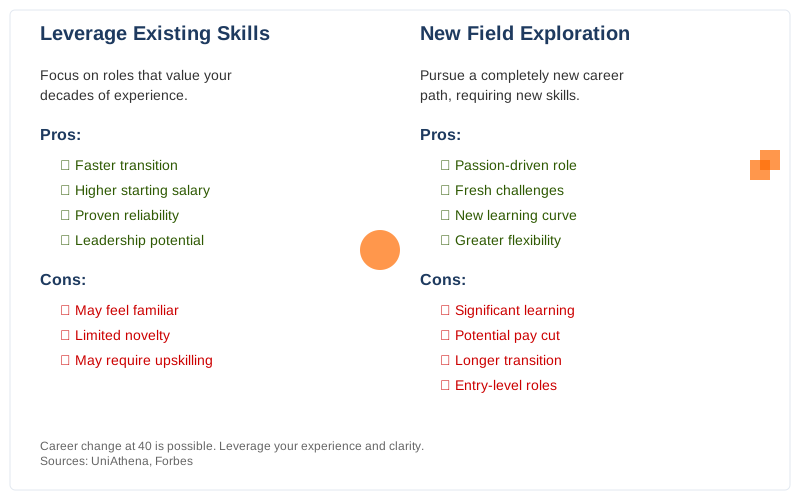
Comparison overview for career change 40 years old
Key Takeaways
Your 40s are a prime time for a career change, not a career ending. In 2025, nearly 50% of those aged 40-45 are actively exploring new roles for better pay, purpose, and flexibility UniAthena. You possess decades of experience, clarity on what you *don't* want, and a resilience younger candidates lack Turing College.
Identify and translate your transferable skills. Don't just list past job duties; frame them as problem-solving capabilities. A background in client relations, for instance, translates to strong stakeholder management Gail Golden Consulting. Employers value your leadership, stability, and decision-making skills UniAthena.
Network strategically and multigenerationally. Leverage your existing contacts, but also connect with early and mid-career professionals. They offer current insights into industry trends and hiring practices Gail Golden Consulting.
Research the market and required skills thoroughly before making a leap Reddit. High-demand fields like data analytics and cybersecurity are experiencing significant growth UniAthena.
The single most important thing a recruiter would tell you off the record? Stop thinking of your age as a barrier and start thinking of it as your superpower. Your combined experience, clarity, and proven ability to learn are what make you a valuable, often preferred, candidate for roles requiring significant responsibility.
To enhance your transition, consider effective networking strategies that can open new doors in your career.
Frequently Asked Questions
What are the biggest hurdles when looking to switch careers in my 40s?
Honestly, the biggest hurdle isn't age itself, but your own mindset. Many people over 40 feel like they're starting from scratch, which isn't true. You have decades of experience and a clarity younger candidates lack. The real challenge is often overcoming self-doubt and the perception that you're too 'late' to pivot, which employers don't actually see as a disqualifier for roles requiring stability and decision-making.
How do I even figure out what skills I have that a new industry might want?
You've been doing this for 20+ years; you have a goldmine of transferable skills. Think beyond your job title. Did you manage projects, lead teams, solve complex problems, or communicate effectively with diverse stakeholders? Even if your previous role was in, say, retail, skills like inventory management, customer service, and negotiation are valuable in logistics or even project coordination roles. Gail Golden Consulting emphasizes identifying both hard and soft skills and how they apply to your target career.
Which industries are actually open to hiring people my age who are switching careers?
The tech and data sectors are surprisingly receptive, especially for roles demanding leadership and analytical thinking. Companies like Amazon, Microsoft, and Deloitte are actively hiring for data analysts and BI experts, reporting significant demand UniAthena's 2026 guide notes. Cybersecurity is another area with massive shortages; IBM and Accenture are among those looking for experienced professionals. Don't discount industries that value your maturity, like consulting, project management, or even certain areas of healthcare administration.
What's the best way to build a network when I'm trying to break into a new field after 40?
Don't just lean on your existing contacts; actively seek out younger professionals in your target industry. Gail Golden Consulting stresses building a multigenerational network. Attend industry-specific meetups (even virtual ones), engage on LinkedIn with people in roles you admire, and don't be afraid to reach out for informational interviews - most people are happy to share their experience for 20-30 minutes.
What should I put on my resume to get noticed when I'm pivoting careers in my 40s?
Forget the chronological dump of every job you've ever had. Focus on a strong summary that immediately highlights your transferable skills and the value you bring to the *new* industry. Use keywords from job descriptions you're targeting, as Applicant Tracking Systems (ATS) like Workday or Taleo will scan for them. Quantify your achievements whenever possible - instead of 'managed projects,' say 'managed 5 cross-functional projects concurrently, delivering them 10% under budget'.