What a Total Compensation Package Actually Includes (2026 Complete Guide)
RoleAlign Team
15 min read
Prices verified February 2026
Includes Video
A job offer email lands, and your eyes immediately lock onto the base salary. It's a natural first reaction, but it's also a critical mistake. Focusing solely on that number means you're likely missing out on tens of thousands of dollars in value.
A job offer email lands, and your eyes immediately lock onto the base salary. It's a natural first reaction, but it's also a critical mistake. Focusing solely on that number means you're likely missing out on tens of thousands of dollars in value. True compensation is a complete package of rewards, both monetary and non-monetary, that an employer provides in exchange for your work. Understanding how to assess this entire package is essential for making informed career decisions.
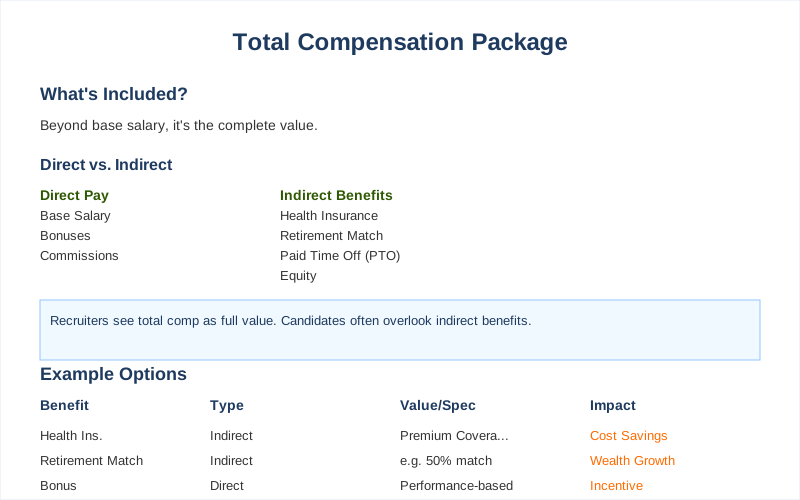
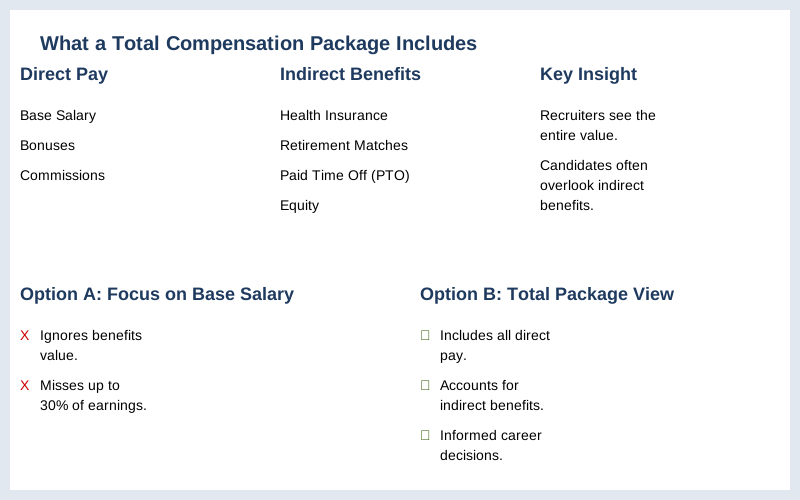
This isn't just about a higher paycheck; it's about understanding the full scope of what your employer offers. A total compensation package includes direct pay like base salary, bonuses, and commissions, alongside indirect benefits such as health insurance, retirement matches, paid time off (PTO), and equity . For instance, about 30 percent of private-industry compensation costs are benefits, with wages and salaries accounting for the remaining 70 percent. That means nearly a third of what employers spend never shows up on a pay stub. This guide will break down what a total compensation package actually includes, moving beyond the base salary to reveal the complete picture.
When evaluating a job offer, it's crucial to look beyond the base salary and consider the entire spectrum of benefits and perks. These indirect benefits can significantly increase the overall value of your employment. For example, a robust health insurance plan, encompassing medical, dental, and vision coverage, can save you thousands of dollars annually in premiums and out-of-pocket expenses. Similarly, employer contributions to retirement plans, such as a 401(k) match, represent direct financial gains that compound over time. Beyond these core benefits, many companies also offer attractive perks like generous paid time off (PTO), which can include vacation days, sick leave, and holidays, allowing for a better work-life balance. Furthermore, opportunities for professional development, such as tuition reimbursement or training programs, can enhance your skills and future earning potential. Some roles might also include performance-based bonuses or commission structures, which, depending on your success, can add substantial amounts to your direct pay. Equity, such as stock options or grants, can also represent a significant, albeit sometimes variable, component of your total compensation, offering a stake in the company's success. Understanding the full breadth of these offerings is key to accurately assessing the true worth of a job opportunity.
Key specifications for What a Total Compensation Package Actually Includes
The Real Answer
Recruiters see a total compensation package as the entire value proposition of employment, not just base salary. Candidates often overlook indirect benefits, which can represent a significant portion of their earnings.
When recruiters evaluate candidates and present offers, they're not just thinking about the base salary. They're considering the full financial picture that an employer provides. This includes everything of value an employer offers in exchange for an employee's work, encompassing both direct pay and indirect benefits. Understanding this total compensation package explained is crucial for both parties.
Direct compensation includes the obvious: base salary, plus any expected bonuses or commissions. These are the numbers that typically appear on a pay stub. However, the real value often lies in the indirect components. These are benefits that have a tangible monetary worth, even if they aren't paid out directly as cash. Qobra highlights that indirect benefits include health insurance, retirement plan matches, paid time off (PTO), and equity.
The value of these indirect benefits can be substantial. For instance, employer contributions to retirement plans or the cost of health insurance premiums can add tens of thousands of dollars to your overall compensation. CompLogix notes that about 30 percent of private-industry compensation costs are benefits, with wages and salaries accounting for the remaining 70 percent. This means nearly a third of what employers spend never shows up on a pay stub.
When assessing your offer, break down your total comp breakdown into these two main categories. For direct pay, factor in your guaranteed salary and realistic estimates for bonuses and commissions. For indirect benefits, quantify the value of your health insurance premiums, retirement match percentages, and the potential value of equity like RSUs or stock options. Even PTO has a calculable value; for example, its worth can be estimated by dividing your annual salary by 260 workdays and multiplying by the number of paid days off Qobra. Always negotiate for the entire package, not just the base salary Workday US.
A handshake signifies a successful agreement, highlighting how a total compensation package goes far beyond just salary, often including valuable indirect benefits.
| Photo by www.kaboompics.com
A handshake signifies a successful agreement, highlighting how a total compensation package goes far beyond just salary, often including valuable indirect benefits.
| Photo by www.kaboompics.com
What's Actually Going On
1
ATS Parsing - Applicant Tracking Systems (ATS) are the first gatekeepers, looking for keywords and structured data. Recruiters use Boolean searches or keyword filters to narrow down resumes. If your resume doesn't clearly highlight relevant skills and experience using industry-standard terminology, the ATS might discard it. Tailoring your resume for each role, incorporating keywords from the job description, is critical for passing this initial hurdle. This initial scan is purely algorithmic, meaning it prioritizes precise matches over nuanced understanding of your capabilities.
2
Recruiter Screening - After the ATS, recruiters scan your resume and LinkedIn profile. They assess your fit for the role and company culture, but more importantly, they evaluate total compensation package potential. They estimate your expected base pay, bonus potential, and benefits. Robert Half's 2026 Salary Guide highlights how recruiters use benchmarks to understand market rates. They gauge if your expectations align with what the company can offer. This evaluation involves considering not just the salary you might be seeking, but also the broader financial and non-financial rewards the company typically provides. Recruiters are essentially trying to determine if your anticipated needs can be met within the company's established compensation structure, which often includes direct pay (base salary, bonuses, commissions) and indirect benefits (health insurance, retirement plans, paid time off, and equity) as outlined by Qobra's guide.
3
Hiring Committee Decisions - The hiring committee makes the final decision, focusing on skills, experience, and cultural alignment. The offer is heavily influenced by budget and compensation philosophy. Startups may offer more equity, while enterprises have structured benefits and bonus programs. In tech, bonuses and equity can be significant; finance may lean on guaranteed bonuses and commissions. At senior levels, negotiation shifts to equity, bonuses, and long-term incentives. The committee's decision is a holistic one, weighing your potential contribution against the cost of your total compensation package, which encompasses everything of value provided by the employer in exchange for your work, as defined by Career Group Companies. This includes direct monetary compensation and various forms of indirect compensation.
4
Company Size and Industry Impact - The total comp breakdown varies. Startups might offer lower base salaries but higher equity for long-term upside. Qobra's guide notes equity value can be significant but volatile. Large enterprises offer robust benefits like comprehensive health insurance and retirement matching. Tech often features stock options or RSUs; finance emphasizes performance bonuses and commissions. Healthcare compensation may include specialized certifications or on-call bonuses. For instance, a startup's compensation package might heavily feature stock options, aiming to align employee interests with long-term company growth, while a large financial institution might prioritize substantial annual bonuses tied to individual and team performance, alongside a more generous retirement plan match. The structure of direct pay and indirect benefits is highly dependent on the industry's norms and the company's stage of development, as noted by AIHR.
5
Seniority Level Influence - As seniority increases, so does the complexity and value of the total compensation package. Junior roles focus on base salary and standard benefits. Mid-level professionals see more emphasis on performance bonuses and smaller equity grants. Senior and executive roles include significant equity, substantial annual bonuses, retention bonuses, and perks. Workday's CFO Salary Guide shows executives negotiate the entire package, not just base pay. At the executive level, compensation discussions often extend to include not only base salary, annual bonuses, and equity grants, but also long-term incentive plans (LTIPs), stock appreciation rights (SARs), and other performance-driven awards designed to retain top talent and incentivize sustained high performance. This comprehensive approach to compensation recognizes the strategic impact and leadership responsibilities at higher levels, moving beyond simple salary discussions to encompass a much broader spectrum of value. Rippling's blog further emphasizes that total compensation is a multifaceted offering.
As companies explore innovative payment methods, understanding how compensation is determined becomes increasingly important.
Analyzing data on dual screens shows the detailed work involved in understanding your worth, crucial for a clear compensation package explained.
| Photo by Kampus Production
Analyzing data on dual screens shows the detailed work involved in understanding your worth, crucial for a clear compensation package explained.
| Photo by Kampus Production
How to Handle This
1
Research the market data - Before you even think about negotiating, you need to know your worth. Use resources like the Robert Half 2026 Salary Guide to understand typical salary ranges for your role, experience level, and industry. This research is crucial because recruiters use this data to benchmark offers. If you skip this, you risk accepting an offer significantly below market value, potentially missing out on tens of thousands of dollars in your total compensation package. For senior roles or niche industries, supplementing with industry-specific salary surveys or consulting compensation data platforms like Qobra is essential for accurate benchmarking.
2
Deconstruct the offer letter - When an offer arrives, don't just fixate on the base salary. Recruiters present a full total compensation package, which includes direct pay (base salary, bonuses, commissions) and indirect benefits (health insurance, retirement match, PTO, equity) Qobra. About 30 percent of private-industry compensation costs are benefits, meaning a significant portion of your value isn't on the pay stub CompLogix. If you ignore benefits like a 6 percent 401(k) match or equity, you're undervaluing the offer by as much as a third. Always ask for a detailed breakdown of all components.
3
Quantify indirect benefits - Indirect compensation often holds substantial value. For example, PTO value can be calculated as your Annual Salary divided by 260 days multiplied by the number of paid days Qobra. Similarly, understand the actual value of equity: RSUs are vested shares multiplied by market price, while options represent potential spread above the strike price, factoring in vesting and IPO uncertainty. Recruiters hope you'll overlook these details, making it easier to present a less competitive offer. Failing to quantify these elements means you can't effectively compare offers or negotiate for their true worth.
4
Negotiate the entire package - Always negotiate for both base salary and the broader compensation package, which should include bonuses, equity, and other incentives Workday US. Recruiters use the total compensation figure to assess your overall offer. If you only push for base salary, they might concede there but hold firm on other valuable components, leaving your overall compensation stagnant. A strategic negotiation addresses all aspects-bonus targets, severance, professional development stipends, or even the value of flexible work arrangements-to ensure you're getting a fair deal across the board. This demonstrates to the recruiter you understand the full scope of the employment relationship.
Working with large-scale data analysis in a control room mirrors the complexity of understanding a total comp breakdown, emphasizing research.
| Photo by SpaceX
Working with large-scale data analysis in a control room mirrors the complexity of understanding a total comp breakdown, emphasizing research.
| Photo by SpaceX
What This Looks Like in Practice
TOPIC: What a Total Compensation Package Actually Includes
SECTION: real_scenarios — ## What This Looks Like in Practice
Senior Software Engineer at a Series B Startup: Received a competitive base salary alongside a significant equity grant with a vesting schedule. While the equity offered substantial upside potential, the lack of a guaranteed annual bonus meant income could fluctuate. The startup also provided a robust health benefits package and a generous PTO policy. This equity component is crucial, as it aligns the employee's success with the company's growth, a common strategy in early-stage companies seeking to attract top talent without the immediate cash flow of larger corporations How to Calculate Compensation: Step-by-Step Guide for 2026 - Qobra.
Entry-Level Data Analyst at a Fortune 500 Company: This role offered a predictable base salary and a clear path for annual raises tied to performance reviews. The compensation package included a standard benefits suite, such as health insurance and a retirement savings plan with an employer match. However, the bonus structure was modest and less performance-driven compared to startup roles, and opportunities for equity were non-existent. The employer match on the retirement plan is a direct financial benefit, effectively increasing the employee's savings for the future 2026 Salary Guide.
Career Changer to Product Management (Mid-Level): Transitioning roles meant negotiating a new base salary that reflected acquired product skills, not just years of experience. The offer included a performance-based bonus target, representing a key component of the total compensation. Benefits were comprehensive, mirroring those of established tech companies, though direct equity was not part of the initial package. The inclusion of a performance-based bonus indicates a recognition of the value of specific, measurable achievements in this new role How to Calculate Compensation: Step-by-Step Guide for 2026 - Qobra.
Sales Director at a SaaS Company: The compensation structure was heavily weighted towards variable pay. This included a substantial commission plan based on hitting sales targets, alongside a solid base salary. The total compensation package also featured a significant annual bonus opportunity, comprehensive health benefits, and a retirement savings plan. This commission-heavy structure is typical in sales, directly linking employee earnings to revenue generation and company success Types of Compensation: A 2026 Guide for HR.
Understanding cryptocurrency compensation can also highlight issues around equity in pay, as discussed in our article on pay discrimination.
Focusing on data protection on multiple screens illustrates the critical, often complex, elements that contribute to a comprehensive compensation package explained.
| Photo by Tima Miroshnichenko
Focusing on data protection on multiple screens illustrates the critical, often complex, elements that contribute to a comprehensive compensation package explained.
| Photo by Tima Miroshnichenko
Mistakes That Kill Your Chances
Mistake Focusing solely on base salary.
Why candidates make it It's the most visible and straightforward number. Many candidates are trained to negotiate salary above all else.
What recruiters actually see A candidate who undervalues the entire compensation package, potentially missing out on significant financial benefits. This signals a lack of understanding of a company's total rewards strategy.
The fixAlways negotiate for both base salary and total compensation package, which should include bonuses, equity, and other incentives Workday US. Treat the entire offer as a negotiation.
Mistake Ignoring or downplaying benefits and perks.
Why candidates make it Benefits like health insurance or retirement matching can seem less tangible than cash, or candidates may not fully grasp their monetary value. New grads often underestimate the long-term impact of retirement contributions.
What recruiters actually see A candidate who doesn't appreciate the substantial investment companies make in their employees' well-being. This can indicate a short-sighted career perspective. According to a People Managing People analysis, about 30 percent of private-industry compensation costs are benefits CompLogix.
The fixQuantify the value of benefits. Understand the employer's retirement match, health insurance premiums they cover, and the value of Paid Time Off (PTO). For RSUs, calculate the vested shares per year multiplied by the market price Qobra.
Mistake Not accounting for variable compensation's unpredictability.
Why candidates make it Candidates often assume they will hit their bonus or commission targets, especially if the potential payout is high. This is particularly true for sales roles or those with performance-based bonuses.
What recruiters actually see A candidate who overestimates their guaranteed income. Recruiters know that bonuses and commissions are not guaranteed and depend on performance and market conditions. This can lead to unrealistic expectations about their total comp breakdown.
The fixBe conservative when estimating variable pay. Use the lower end of potential bonus ranges or factor in historical commission payout data if available. Understand the commission structure and any accelerators or caps Qobra.
Mistake Overvaluing early-stage equity for senior roles.
Why candidates make it Senior candidates may be tempted by significant stock option grants, assuming a future IPO or acquisition will make them rich, without fully assessing the risk and dilution.
What recruiters actually see A candidate who doesn't grasp the long-term financial realities of equity, especially in volatile startups. They may be prioritizing a speculative upside over guaranteed compensation.
The fixScrutinize equity terms carefully. Understand vesting schedules, strike prices, dilution clauses, and the company's funding status. Compare the potential spread above the strike price against the risk of the investment becoming worthless Qobra.
Mistake Assuming all benefits are equal across companies.
Why candidates make it Candidates might see "health insurance" listed and assume it's comparable everywhere, without digging into plan details, deductibles, or employer contributions.
What recruiters actually see A candidate who lacks a nuanced understanding of employee benefits. Recruiters know that the quality and cost of benefits vary dramatically, impacting the true value of the total compensation package.
The fixAsk specific questions about benefits. Inquire about the percentage of health insurance premiums covered by the employer, HSA contributions, and the specifics of retirement plans. This demonstrates a commitment to understanding the full value proposition Juicebox.
To enhance your total compensation, understanding how to effectively negotiate your salary can be crucial, so consider learning about asking for a raise.
Product comparison for What a Total Compensation Package Actually Includes
Key Takeaways
Understand that your total compensation package is far more than just your base salary. It encompasses direct pay like bonuses and commissions, alongside indirect benefits such as health insurance, retirement matching, and paid time off (PTO) How to Calculate Compensation: Step-by-Step Guide for 2026 - Qobra. This broader scope often includes elements like stock options, profit sharing, and even professional development opportunities.
Recognize that indirect benefits can represent a significant portion of your overall compensation, sometimes accounting for up to 30 percent of an employer's compensation costs What a Total Compensation Package Really Includes - CompLogix. This means a substantial amount of value might not appear on your pay stub. For instance, employer contributions to a 401(k) plan, the cost of group life insurance, or the value of tuition reimbursement programs all contribute to this substantial, often overlooked, portion of your earnings.
When negotiating, always consider the entire compensation package, including equity, bonuses, and other incentives, not just the salary figure alone The Definitive 2026 CFO Salary Guide | Workday US. This holistic view is crucial for making informed career decisions. For example, a slightly lower base salary might be more than offset by a generous annual bonus structure or valuable stock options that appreciate over time.
Ultimately, the most important thing a recruiter would tell you off the record? Quantify everything. Don't just accept numbers; understand the real dollar value of your benefits, equity, and bonus potential so you can accurately assess and negotiate your worth. This involves looking beyond stated values and understanding the actual cost to the employer and potential return to you, whether through market value of stock options or the premium of health insurance plans.
Understanding non-compete clauses is just one aspect; it’s equally important to evaluate the overall value of a job offer, so consider our insights on job offer evaluation.
Frequently Asked Questions
Beyond my base salary, what else should I be looking at in a job offer?
Your total compensation package includes more than just your base salary; it encompasses direct pay like bonuses and commissions, plus indirect benefits such as health insurance, retirement plan matching, paid time off, and equity or stock options. Understanding these components is crucial because benefits can represent a significant portion of your overall earnings, sometimes up to 30% according to some analyses. CompLogix highlights that focusing only on salary means missing out on the full value of your employment. Qobra emphasizes evaluating the whole package for informed career decisions.
Can you break down what makes up a total compensation package?
A total compensation package is everything of value an employer offers in exchange for your work, and it's typically divided into direct and indirect components. Direct compensation includes your base salary, bonuses, and commissions, while indirect compensation covers benefits like health insurance, retirement contributions (e.g., 401(k) match), paid time off (PTO), and equity like stock options or RSUs. AIHR notes that these elements are key for attracting and retaining talent. Paycom confirms this includes all financial and non-financial benefits.
How much are benefits typically worth compared to base salary?
Benefits can significantly add to your overall compensation, often accounting for around 30% of an employer's total compensation costs, with wages and salaries making up the remaining 70%. This means a substantial part of your employment value might not appear on your paycheck. CompLogix points out that employees often undervalue their packages because the full picture isn't clearly presented. Qobra suggests calculating the value of PTO and equity to get a clearer picture.
What's the difference between salary and total compensation?
Salary is the fixed amount you receive regularly, while total compensation is a broader measure that includes your salary plus all other forms of value from your employer. This includes variable pay like bonuses and commissions, as well as indirect benefits such as health insurance premiums paid by the employer, retirement plan matches (e.g., a 6% 401(k) match can be substantial), and the value of paid time off. Career Group Companies defines total compensation as anything of value provided by the employer. Brightmine describes it as everything offered in exchange for services.
Are bonuses and stock options always part of a job offer's total compensation?
Bonuses and stock options are common components of a total compensation package, especially in certain industries, but they are not guaranteed in every offer. Bonuses can be performance-based or discretionary, while stock options or Restricted Stock Units (RSUs) are often used to align employee interests with company growth. Paycom lists equity as a potential element. Qobra provides methods for valuing equity, noting that it's important to consider vesting schedules and potential market fluctuations.