Understanding the WARN Layoff List: What You Need to Know About Workplace Reductions
RoleAlign Team
13 min read
Includes Video
You just got the rejection email. Again. Staring at your ATS dashboard, you wonder if there's a pattern you're missing, a signal you're not picking up. While you're meticulously tweaking your resume, thousands of employees are already bracing for impact.
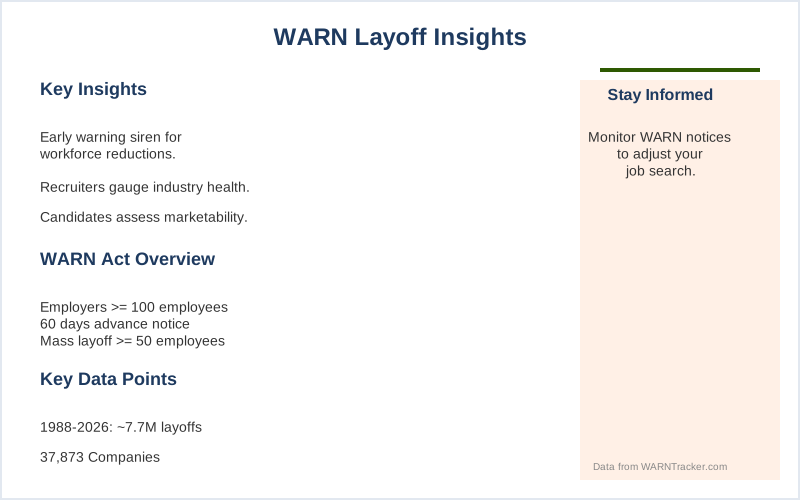
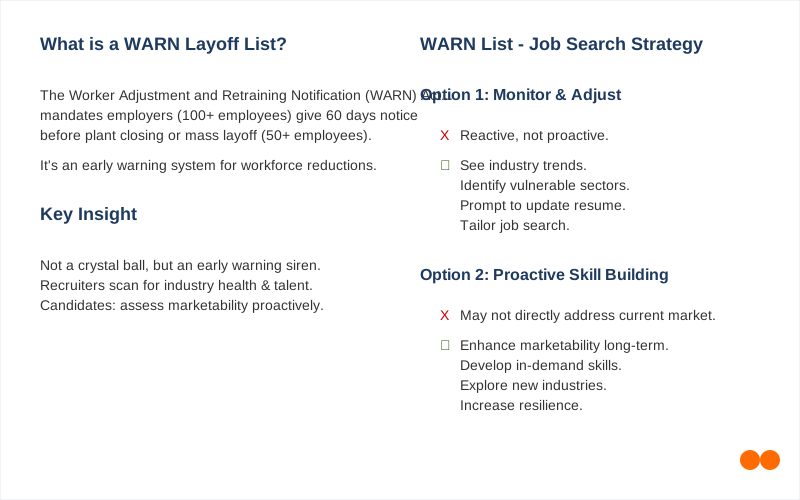
You just got the rejection email. Again. Staring at your ATS dashboard, you wonder if there's a pattern you're missing, a signal you're not picking up. While you're meticulously tweaking your resume, thousands of employees are already bracing for impact. That's where the WARN layoff list comes in. The Worker Adjustment and Retraining Notification (WARN) Act mandates that employers with 100 or more employees provide at least 60 days advance written notice before a plant closing or mass layoff affecting 50 or more employees Employer's Guide to Advance Notice of Closings and Layoffs. This isn't just bureaucratic paperwork; it's a critical early warning system. Data shows that from 1988 to 2026, an estimated 7.7 million employees were laid off from 37,873 companies Live Layoffs from Public WARN records - WARNTracker.com. Understanding this list isn't about predicting doom, but about recognizing the seismic shifts in the job market before they hit your inbox. It's about seeing where the ground is moving so you can adjust your job search strategy accordingly.
Key specifications for WARN layoff list
The Real Answer
A WARN layoff list isn't a crystal ball predicting your future, but it IS an early warning siren for significant workforce reductions. Recruiters often scan these lists to gauge industry health and anticipate talent availability, while candidates should see them as a prompt to proactively assess their own marketability.
The Worker Adjustment and Retraining Notification (WARN) Act mandates that employers with 100 or more employees provide at least 60 days advance written notice of a plant closing or mass layoff affecting 50 or more employees [PDF] Employer's Guide to Advance Notice of Closings and Layoffs. This federal requirement, often supplemented by state "mini-WARN" laws (like California's covering employers with 75+ employees or New York's requiring 90 days' notice for employers with 50+), means these notices are public record. WARNTracker.com, for instance, aggregates these filings, showing millions of employees affected by layoffs from tens of thousands of companies since 1988 Live Layoffs from Public WARN records - WARNTracker.com.
From a recruiting perspective, a WARN layoff list is a valuable intelligence source. It signals which companies are undergoing significant restructuring, potentially freeing up talent pools in specific roles and industries. We're not just looking at the numbers; we're analyzing the types of positions being eliminated, as seen in aggregated notices listing specific job titles like "Applied Scientist III" or "UX Designer III." This helps us anticipate where candidates might emerge and adjust our sourcing strategies.
Candidates often view WARN notices with dread, and understandably so. However, a more strategic approach involves seeing them as a call to action. If your current employer or a competitor files a WARN notice, it's a clear signal to update your resume, refresh your LinkedIn profile, and start networking. Don't wait until you're directly impacted; proactive preparation is key.
It's crucial to understand that not every company complies perfectly, and some exceptions exist. For example, a "faltering company" actively seeking financing might have reduced notice periods WARN Act (layoff notice) Checklist | Workforce.com. Furthermore, not all states have robust WARN laws, meaning the publicly available data, while extensive, may not capture every single layoff event.
Understanding the distinction between workforce reduction and layoff can significantly influence your career decisions, as detailed in this insightful article.
A worried professional studies a WARN layoff list, highlighting the emotional impact of impending workforce reductions. These lists signal significant layoffs ahead.
| Photo by Anna Shvets
A worried professional studies a WARN layoff list, highlighting the emotional impact of impending workforce reductions. These lists signal significant layoffs ahead.
| Photo by Anna Shvets
What's Actually Going On
1
The WARN notice is a legal signal. The federal Worker Adjustment and Retraining Notification (WARN) Act mandates that employers with 100 or more employees give at least 60 days' written notice of a plant closing or mass layoff affecting 50 or more employees U.S. Department of Labor. Some states, like Iowa, have "mini-WARN" laws covering smaller employers or requiring longer notice periods Iowa Workforce Development. This data is publicly filed, allowing you to track patterns and predict where layoffs might occur.
2
How the WARN list impacts job searching is indirect but significant. Recruiters and hiring managers are aware of the industry trends WARN lists reveal. A WARN notice indicates an upcoming reduction in force (RIF), often leading to a hiring freeze or a push to fill critical roles *before* layoffs begin. If you're looking at companies with recent WARN filings, expect fewer opportunities or a more competitive internal environment.
3
ATS parsing and recruiter screening are where WARN list influence is indirectly felt. While an ATS like Workday or Greenhouse won't flag your application based on a WARN notice, the *recruiter* will. They see these filings and know their client company is in a cost-cutting or restructuring phase, often under pressure to reduce headcount. Your application might be deprioritized if the company is actively laying off or if your role is deemed non-essential.
4
Hiring committee decisions become more scrutinized during periods signaled by WARN notices. In startups, a WARN notice might mean a pivot or funding cut, leading to fewer open roles and a focus on essential hires. Enterprise companies may use WARN filings to signal departmental restructuring. For tech roles, a WARN notice in a specific sector can ripple outwards, affecting hiring across the board. In finance, WARN filings often precede consolidation or regulatory changes. Healthcare might see WARN notices tied to hospital system mergers or shifts in service offerings.
5
Seniority level matters when interpreting WARN list data. Entry-level and mid-level roles are often cut first during mass layoffs. Senior-level and highly specialized roles might be more protected, unless the layoff is due to a complete business unit closure or a strategic overhaul. The WARNTracker.com database shows millions of employees laid off from tens of thousands of companies since 1988, indicating these trends are long-standing.
To understand the broader context of layoffs, explore our real-time insights into workforce changes.
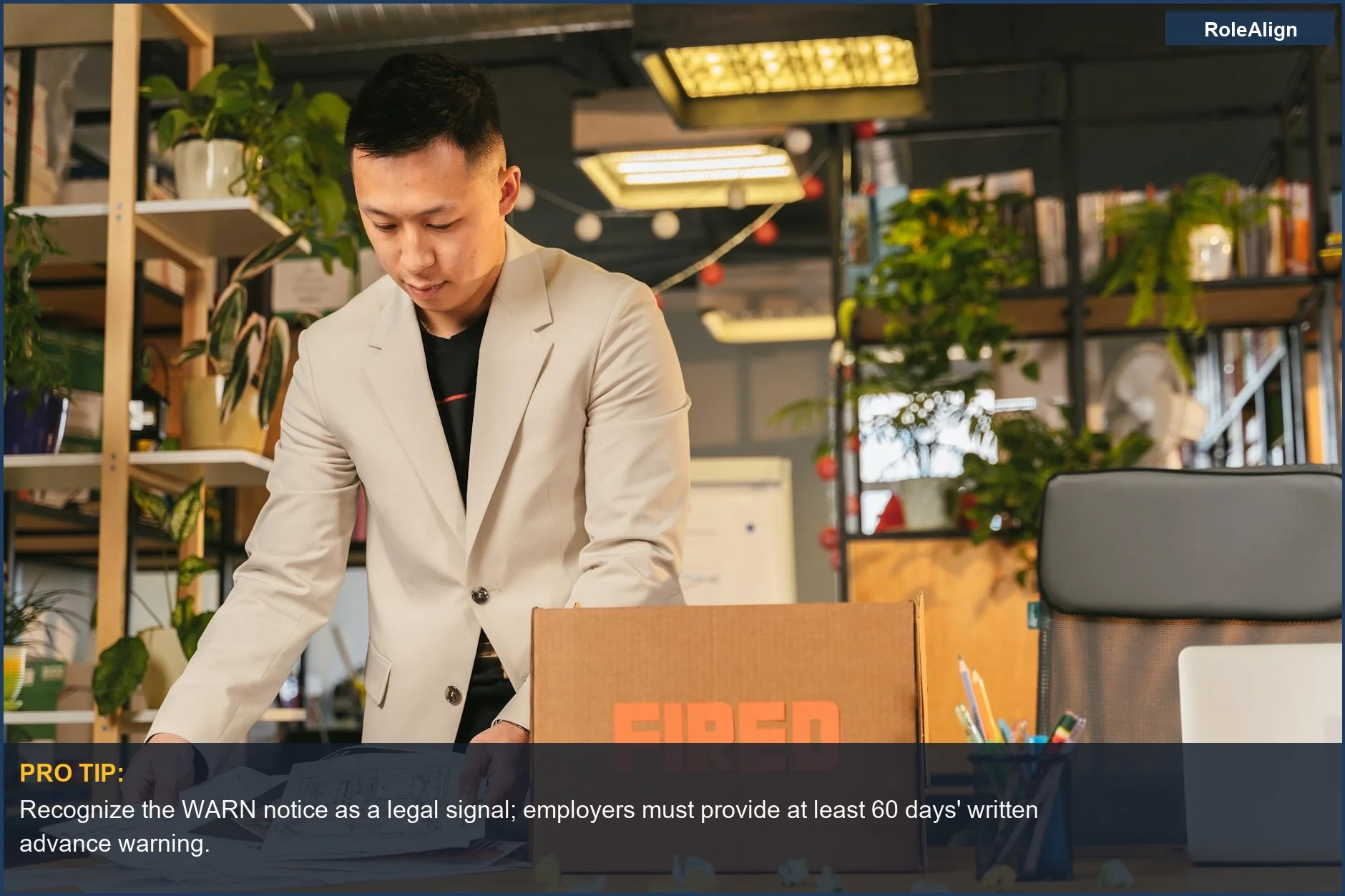
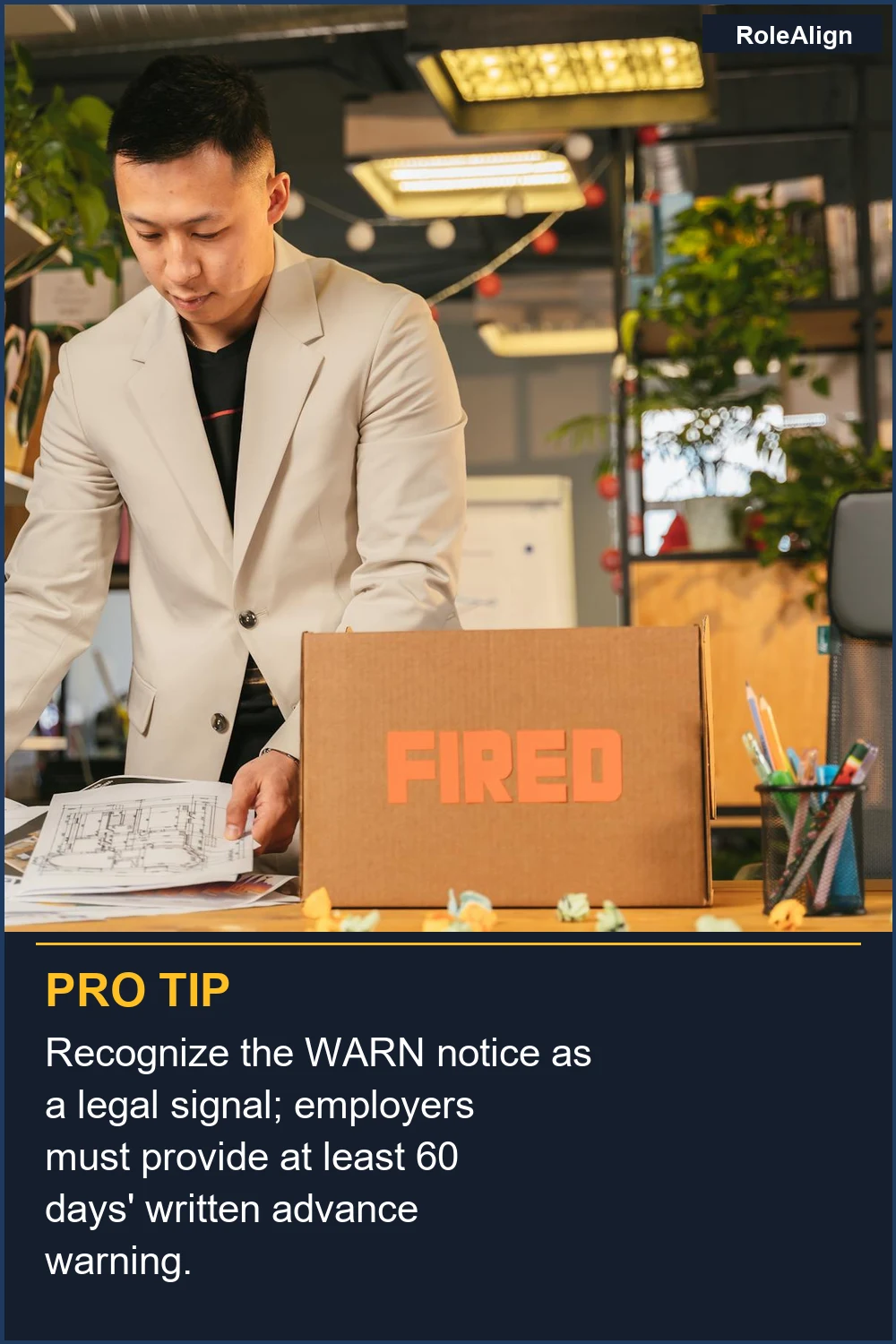
Packing up belongings after a WARN notice, this image represents the tangible impact of job loss. The WARN Act mandates advance notification for major layoffs.
| Photo by ANTONI SHKRABA production
Packing up belongings after a WARN notice, this image represents the tangible impact of job loss. The WARN Act mandates advance notification for major layoffs.
| Photo by ANTONI SHKRABA production
How to Handle This
1
Monitor WARN Notices Daily - The WARN Act requires employers with 100 or more employees to provide at least 60 days' advance written notice of mass layoffs or plant closings WARN Act. This means that once a notice is filed, you have a minimum of two months before the actual job loss occurs, giving you a crucial window to act. Recruiters and hiring managers often scan these lists for talent that suddenly becomes available, especially for senior or specialized roles where replacement is difficult. Skipping this means you're reacting to layoffs after they've happened, not proactively positioning yourself.
2
Target Companies with Recent Filings - If you see a company on a WARN layoff list, it's a direct signal of internal turmoil. The rationale for recruiters? These companies are in a state of flux, meaning they might be more open to external hires to fill gaps or replace departing talent. For the job seeker, this is your prime opportunity. Reach out to contacts *within* that company, not just the HR department. A referral from someone who knows the internal challenges is gold. If you skip this, you're just another applicant in a generic pool, and your application might get lost in the shuffle as the company deals with its internal restructuring.
3
Tailor Your Approach for Senior Roles - For senior-level positions (Director, VP, etc.), a WARN notice is a strong indicator that a company might be looking to bring in fresh leadership or replace key figures. Recruiters will be actively seeking experienced candidates who can step in quickly. Your outreach should be direct and highlight your ability to solve immediate problems. Use LinkedIn to connect with hiring managers or relevant department heads, referencing the public WARN filing and offering your expertise. A generic email or application will be ignored; recruiters know senior hires are critical and need targeted engagement. Failing to customize means you're not speaking their language or addressing their urgent needs.
4
Leverage State-Specific "Mini-WARN" Acts - Don't just rely on the federal WARN Act. Some states have their own "mini-WARN" laws with lower employee thresholds or longer notice periods. For example, New York's law requires 90 days' notice for employers with 50 or more employees, while Iowa's law covers employers with 25 or more employees with 30 days' notice WARN Act. Recruiters use this information to understand the precise timeline of available talent in specific regions. If you ignore these nuances, you might miss a critical application window or underestimate the urgency of a layoff situation in certain states.
Understanding how layoffs are determined can provide valuable context, so consider exploring how layoff decisions are made.
A stark termination message on a computer screen underscores the reality of job loss. Staying informed about WARN layoff lists is crucial for job seekers.
| Photo by Ron Lach
A stark termination message on a computer screen underscores the reality of job loss. Staying informed about WARN layoff lists is crucial for job seekers.
| Photo by Ron Lach
What This Looks Like in Practice
Senior Software Engineer at a Series B Startup: A Series B startup announced layoffs following a "strategic realignment" and product pivot. Engineers on the defunct feature were disproportionately affected. Those with strong cross-functional skills and experience in the new product focus were retained or quickly found new roles. Deep specialists in the deprecated technology struggled due to limited transferability, aligning with industry reports on specialized roles' vulnerability during strategic shifts WARNTracker.com.
Entry-Level Data Analyst at a Fortune 500: A Fortune 500 company's restructuring and pursuit of operational efficiencies led to layoffs in analytics. Junior analysts lacking specialization or demonstrated impact on key metrics were let go. Analysts who developed AI/ML skills or understood specific business units were better positioned. Those performing only basic data cleaning and reporting without deeper insights struggled to demonstrate value, a common observation in large-scale reductions Worker Adjustment and Retraining Notification (WARN).
Product Manager at a Mid-Sized SaaS Company: Facing market headwinds, a SaaS company's WARN notice targeted product teams. PMs responsible for low-adoption features or those not directly contributing to revenue growth were affected. PMs with a proven track record of revenue-generating product launches or clear ROI articulation were more insulated. Those focused solely on feature development without a link to business outcomes or customer value were laid off, highlighting the importance of demonstrating tangible business impact WARN Act Compliance Assistance | U.S. Department of Labor.
Understanding promotion tactics can also shed light on how companies handle layoffs, as explored in our article on layoff decision-making.
An older gentleman confronts unemployment and a termination notice, illustrating the human side of layoff lists. Experience doesn't always shield one from workforce changes.
| Photo by Ron Lach
An older gentleman confronts unemployment and a termination notice, illustrating the human side of layoff lists. Experience doesn't always shield one from workforce changes.
| Photo by Ron Lach
Mistakes That Kill Your Chances
Mistake
Ignoring WARN notices as a signal of company instability.
Why candidates make it
New grads might see it as just another layoff announcement, while mid-career folks might assume it's a temporary hiccup. Senior leaders might overestimate their own job security.
What recruiters actually see
A WARN notice is a red flag for systemic issues. It signals potential financial distress, organizational restructuring, or a significant shift in business strategy. Recruiters know that companies filing WARN notices are often in flux, making them less stable employment options, even if your specific role isn't initially impacted. A WARN layoff list can precede broader cuts.
The fix
Treat WARN notices as a critical indicator of risk. If a company you're considering, or currently employed by, has filed a WARN notice, investigate further. Understand the scale and scope of the layoff. For new grads, it might mean steering clear of that company entirely. For mid-career and senior individuals, it's a prompt to update your resume and network proactively, even if your role seems safe. The WARNTracker.com database can provide deeper insights into these trends.
Mistake
Assuming WARN notices only apply to blue-collar manufacturing or large-scale tech layoffs.
Why candidates make it
Media coverage often focuses on massive tech layoffs or factory closures. Candidates may not realize the WARN Act applies to a broader range of industries and company sizes, especially with state-level "mini-WARN" laws.
What recruiters actually see
Recruiters understand that WARN notices are a legal requirement for many types of businesses experiencing significant workforce reductions. State laws like California's WARN Act, which covers employers with 75 or more employees, or New York's Mini-WARN Act requiring 90 days' notice for employers with 50 or more employees, broaden the scope Live Layoffs from Public WARN records - WARNTracker.com. They see it as a sign of significant business challenges, not just a sector-specific event.
The fixBroaden your awareness. Understand that a WARN notice from a seemingly stable company in any sector could signal underlying problems. For all career stages, this means researching companies thoroughly and not dismissing a WARN filing as irrelevant to your industry or role.
Mistake
Focusing solely on the layoff date in a WARN notice and ignoring the advance notice period.
What recruiters actually see
The 60-day notice period is a critical window for proactive planning. Recruiters know that companies filing WARN notices are signaling future challenges, and employees who are paying attention can use this time to their advantage. They see candidates who understand this as more strategic and better prepared.
The fix
Treat the WARN notice as a 60-day warning system. For new grads, this is time to refine their job search strategy. For mid-career and senior professionals, it's an opportunity to network aggressively, update their professional profiles, and explore new opportunities *before* the layoffs officially occur.
Mistake
Believing that a WARN notice guarantees every listed employee will be laid off.
Why candidates make it
The official nature of a WARN notice can lead to an assumption of certainty. Candidates might interpret the list as a definitive roster of those affected.
What recruiters actually see
Recruiters understand that WARN notices are legal requirements based on projections. The actual number of affected employees can fluctuate. Companies may adjust layoff plans, offer voluntary separation packages, or even rescind some notices. They see candidates who overreact to WARN lists as potentially misinformed or prone to panic.
The fix
View WARN lists as strong indicators, not absolute decrees. While they signal significant workforce reductions, wait for official communications from the company. For all career stages, focus on understanding the *reasons* behind the WARN notice and the company's overall financial health, rather than fixating on specific names on a preliminary list.
A WARN filing doesn't always mean every listed role is cut; plans can shift. However, these notices strongly indicate upcoming instability and potential job losses across various sectors Live Layoffs from Public WARN records - WARNTracker.com.
Track WARN filings using sites like WARNTracker to see trends and companies signaling layoffs. This data reveals industries and employers in distress, information many recruiters and hiring managers also monitor.
The single most important thing a recruiter would tell you off the record? "The WARN list is your early warning system. If you see your company or a major employer you're targeting on it, start networking and updating your resume yesterday. Don't wait for the official announcement; by then, it's often too late to get ahead of the curve.
What's the deal with official layoff notifications and who has to file them?
Basically, the federal WARN Act mandates that employers with 100 or more employees must give a heads-up at least 60 days before a mass layoff or plant closing that affects 50 or more employees. This notice is meant to give affected workers time to prepare and look for new opportunities. Some states, like California and New York, have their own 'mini-WARN' laws that might cover smaller employers or require longer notice periods.
How does this official layoff notice requirement impact jobs in different sectors?
The WARN Act applies broadly across industries, but you'll see it more frequently in sectors prone to large-scale workforce adjustments, like manufacturing, tech, and retail, especially during economic downturns or significant business restructuring. While the federal law sets a baseline, state-specific 'mini-WARN' laws can add extra layers of protection or coverage for employees in certain regions or industries.
My company is suddenly in the news for a WARN notice. What's my next move?
First, don't panic, but do get organized. Review the notice carefully for specifics like layoff dates and severance details. Immediately update your resume and LinkedIn profile, and start networking actively; many companies that issue WARN notices are looking for immediate replacements. Leverage any outplacement services your employer offers, as they can be surprisingly helpful.
Are there any actual benefits or protections for employees when a WARN notice is issued?
The primary protection is the 60-day advance notice, giving you a crucial window to find new employment before your last day. This notice period is legally mandated for covered employers. Beyond that, specific benefits like severance pay or continued health insurance are typically outlined in company policy or employment contracts, though the WARN Act itself doesn't mandate these beyond the notice period.
Where can I actually see these public layoff notifications and stay ahead of the curve?
You can find public layoff notifications through state labor department websites or dedicated tracking sites like WARNTracker.com, which aggregates data from various public records. These resources often allow you to search by company, location, or industry, giving you insights into broader layoff trends that might impact your job search or industry.